
An Endoscopy Simulator, also known as an Endoscopic Simulator, is an educational and training tool used as a means of instruction for learners and healthcare professionals who require surgical simulation training. Above all, the goal of using Endoscopy Simulators is to achieve the highest quality diagnostic-therapeutic result while minimizing the risks to the patient. This Endoscopy Simulator article covers key details and resources about the specific surgery simulator for Endoscopic Surgery training.
While learning the skills necessary for endoscopy requires experience and time, this knowledge is also heavily dependent on the trainee’s ability and the instructor’s feedback. This is why having an experienced supervisor to oversee each training module is imperative.
In the past, inexperienced residents and learners would begin their training by performing endoscopies on patients. The concern with this method of education and engagement is that procedure times can become prolonged, patients may experience increased discomfort and pain and, in the worst case scenarios, errors may occur.
With ever-increasing endoscopy costs, along with an increasing demand for advanced, invasive procedures which minimize upper gastrointestinal endoscopy, colonoscopy and flexible sigmoidoscopy training opportunities, endoscopy simulation has been considered to be a newer method of maintaining patient safety. This safety is achieved through a combination of reducing endoscopy errors and achieving better and faster training results, according to the article, “Virtual reality simulators for gastrointestinal endoscopy training.”
The benefits of using Endoscopy Simulators have become more apparent over the last few decades as the overall use of these products has become more widespread. Likely recognizing the training success, Endoscopy Simulators are currently used by a number of medical centers in various countries worldwide, and are actively used in training modules.
To date, these virtual Endoscopic Simulators have demonstrated great potential for endoscopy training. Endoscopic Simulators have enhanced training procedures for upper and lower gastrointestinal endoscopy. Additionally, the benefits are proving more and more prominent across inexperienced trainees. The significant acceleration of the training procedure to the threshold that trainees are said to have acquired adequate and acceptable skills for professional use has thus far shown positive validation of a simulator
View the new HealthySimulation.com Community Surgical Simulation Group to discuss this topic with your Global Healthcare Simulation peers!
How Endoscopy Simulators Work
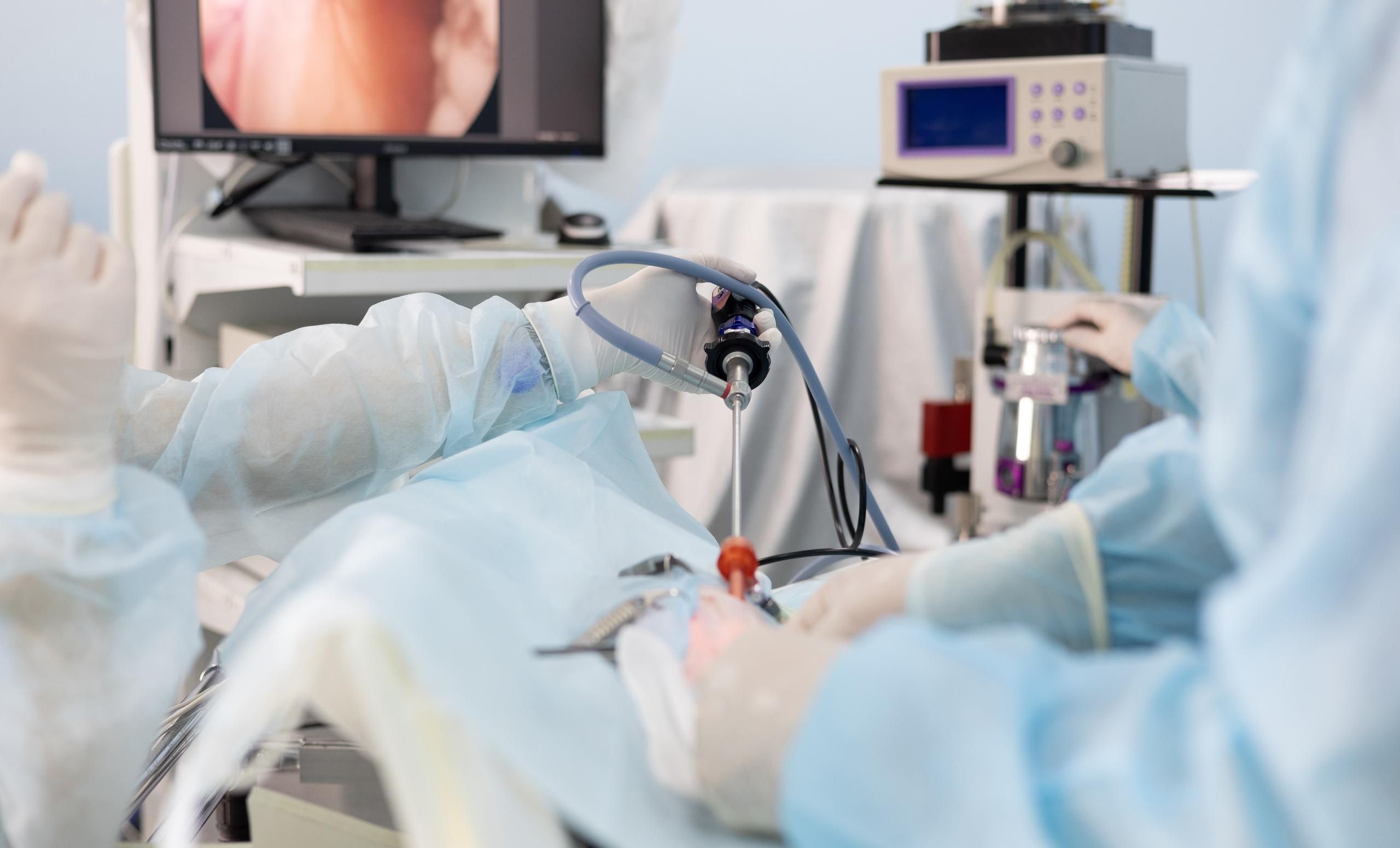
These simulation products are integrated systems that consist of mechanical parts and software. For the training products to operate efficiently, they must run along with a computer program that simulates the procedure of endoscopy. These training procedures use endoscopic images of the gastrointestinal tract while the trainee handles an endoscope that is attached to a processor. Then, the processor is the tool that sends a signal to a monitor for review.
More specifically, the moves of the endoscope will interact with the monitor image, and this interaction provides the trainee with a virtual environment for practicing theoretical and practical knowledge. The environment also works to simulate many different conditions a trainee may later experience while operating first-hand in the field.
Examples of Endoscopic Simulators
Throughout the years, endoscopic simulator availability has been limited in healthcare simulation. Surgical Science’s Simbionix GI Mentor is a family of evidence-based high-videlity simulators for training upper and lower endoscopic procedures. With over 40 validation studies, GI Mentor is the chosen technical skills platform by the Society of American Gastrointestinal and Endoscopic Surgeons (SAGES) for the Fundamentals of Endoscopic Surgery (FES) exam requirements. GI mentor offers a comprehensive library of 120 tasks and virtual patient cases and comes in two versions: either the fully loaded ENDO Suite platform, or the smaller portable GI Express which provides training from foundational skills to advanced endoscopic procedures (such as emergency gastric bleeding), for learners of all stages.
The ENDO Suite platform has lifelike anatomical details and realistic haptic feedback which comes with modules for endoscopic ultrasound (EUS) and endoscopic retrograde cholangiopancreatography (ERCP) training. Overall, this simulation program is especially useful for training with features like a pain indicator and scope locator. GI Express is the portable, table-top version of the simulator which allows for a variety of training setups. By using the GI Mentor, trainees can practice on virtual patient cases based on actual medical data to hone and master their fundamental endoscopic skills before entering clinical environments.
Kyoto Kagaku is another healthcare simulation company, based in Japan, established in 1948 who develops and distributes a variety of healthcare simulation training products including phantoms, anatomical models and specimens. The Colonoscope Training Simulator is a standalone, effective endoscopic task trainer which provides an abdominal torso with a soft and flexible colon tube for life-like practice for skills like loop prevention from simple to complex cases. Another task trainer this company provides is the 3D Colonoscope Training Simulator NKS. This provides a three-dimensional representation of the colon, based on an analytical study of CT Colonoscopy (CTC) data. With a transparent skeleton, the task trainer provides hands-on training for a variety of skills, such as short and long alpha loop and N loop training. Both of these task trainers can be placed in three patient positions of left and right lateral and supine.
View the HealthySimulation.com Webinar Mastering Psychomotor Surgical Skills with Non-Dominant Hand Training to learn more!
Another option is the G-Master, a gastric endoscopic submucosal dissection (ESD) training system developed by Kotobuki Medical in collaboration with the National Cancer Center Hospital East in Japan. Its purpose is to replicate real-world clinical ESD procedures in an entirely artificial, non-animal model that allows safe, repeatable practice of complex endoscopic resections.
The system uses a plant-based “VTT Gastric Mucosa” sheet (made largely from konjac flour) to simulate the layered gastric wall, and a rotatable, adjustable mounting mechanism for up to 11 typical cancer-lesion locations (various curvatures, walls, and regions). G-Master enables trainees to practice the full ESD workflow: from injection (to raise submucosal lesions), mucosal incision, submucosal dissection, to lesion removal, essentially simulating the entire procedure from start to finish. This simulator has an open design which allows trainers and learners to watch scope movement externally to enable real-time feedback. Without special biohazard precautions, G-Master can be used in standard endoscopy and simulation suites to enhance realism to enhance skills acquisition and potentially shorten the learning curve in endoscopic procedures before working on patients.
In addition to these products, there are also Endoscopy Simulators available for non-commercial use. An example of these non-commercial products is the Endo TS-1 simulator, a product of Olympus Keymed, Essex in the United Kingdom. The construct validity of this product has thus far been tested in several trials.
Additional Resources for Endoscopic Simulation
The American Society for Gastrointestinal Endoscopy (ASGE) is a global leader for the advancement of digestive care through education, advocacy and growth in endoscopic practice. Through state-of-the-art education and resources, ASGE provides in-person didactic courses, hands-on training, livestream and virtual options like GI Leap. GI Leap is an online learning library including screen-based simulations which supports learners across the entire gastroenterology ecosystem from students to professionals. The modular structure allows learners to access more than fifty procedure masterclasses, clinical webinars and the Gastrointestinal Endoscopy self-assessment program (GESAP).