

Patient Safety, as according to the World Health Organization (WHO), “is the absence of preventable harm to a patient during the process of health care and reduction of risk of unnecessary harm associated with health care to an acceptable minimum.” Common healthcare errors include patients receiving the wrong medications, contracting hospital acquired infections, having the wrong body part removed during surgery, receiving an incorrect diagnosis or having a missed diagnosis or treatment. This HealthySimulation.com article by Founder/CEO Lance Baily will discuss patient safety and how healthcare simulation can improve patient care.
Historical Data About Patient Safety
Despite significant advances in patient care within the United States and around the world, the number of patients harmed in health care is still unacceptably high. The WHO stated in 2024 that approximately 1 in every 10 patients are harmed in health care and that more than 3 million deaths occur annually due to unsafe clinical care. In low-to-middle income countries, the statistic is that 4 in 100 people die from unsafe clinical care. Medical errors are the third cause of death in the USA after heart disease and cancer.
When healthcare is compared to other potentially lethal industries, such as aviation or nuclear power generation, a huge difference in the likelihood of harm becomes evident. Both aviation and nuclear power are considered to be high-reliability industries since, on most days, zero harm occurs. Jumbo jets do not crash every day, and as soon as a crash does occur, the crash is investigated and a cause is identified. For many years in medicine, occasional errors were accepted as inevitable and were seldom reported, spoken about or investigated.
In 1999, the Institute of Medicine published a report entitled To Err is Human: Building a Safer Health System. This report, which was the first significant attempt to quantify the number of errors, estimated that 98,000 people died annually from preventable causes in the US. In 2024, this number has now risen to 250,000 deaths annually in the US due to medical error.
View the HealthySimulation.com Webinar Intradisciplinary Simulation as a Means to Improve Public Health to learn more!
Systems Approach to Prevention of Patient Safety Errors
The Swiss Cheese Model (Jim Reason) depicts errors as a series of layers of Swiss cheese with holes at different places. Usually, an error does not progress through all the layers into a harmful event because one or other of the layers of a cheese block the error. On rare occasions, the holes of the cheese all line up, and the error or series of errors results in patient harm. A systems approach to prevent patient harm accepts that practitioners will on occasion make errors; however, implementation of a series of checks and warnings will prevent the progression of errors through all the layers that cause patient harm.
Need for a National Patient Safety Board
In 2024, bipartisan legislation was introduced to establish A National Patient Safety Board. This is why healthcare simulation needs advocacy, and our voice should be heard to improve patient care and outcomes through improved patient safety.
Reports of Patient Safety Errors
Previously, healthcare practitioners who made mistakes would try to correct the mistake but would often not speak about or report the error for fear of reprisals. One study revealed that over 50% nurses are afraid to speak up when near misses occur because of fear of disciplinary action. According to Peter Drucker, “you can’t manage what you can’t measure”. When the error or near miss occurs, the error must be reported and investigated.
A change in culture occurs when staff are encouraged to report near misses and errors so that system changes can be made to prevent errors now and in the future. A change of culture in healthcare to normalise reports of errors or near misses needs to become more normalised as a non-blame or shame action and to be patient safety centered instead.
Zero Harm (Zero Preventable Deaths)
Many hospitals have adopted a zero harm policy where errors are no longer listed as specific actions but rather that the number of times patients were treated safely e.g. 99% of patients with central lines did not develop infections.
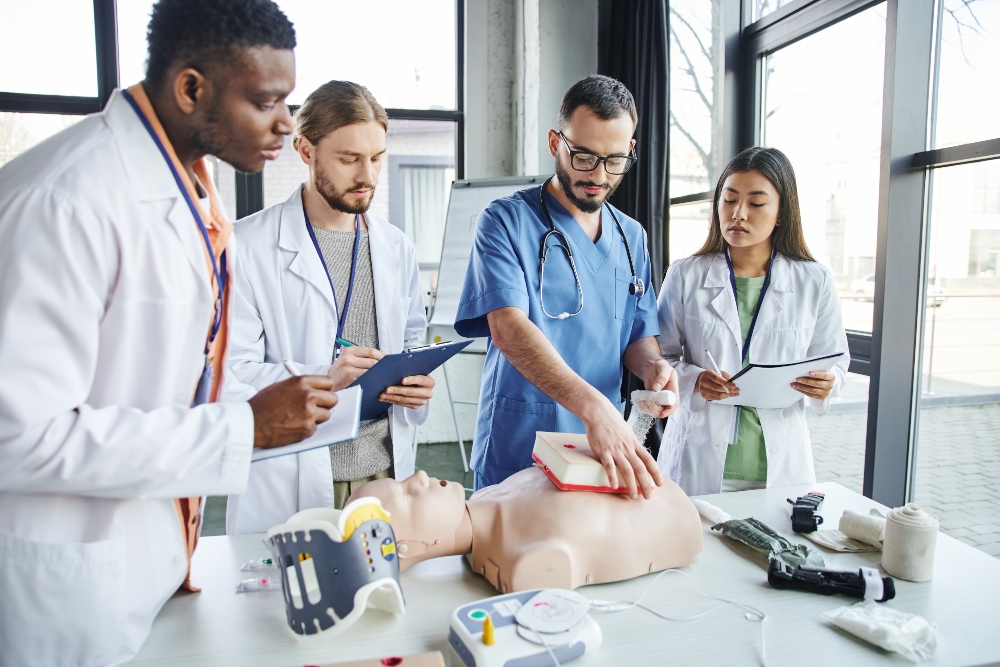
Healthcare simulation plays an increasing role in the creation of a zero patient harm culture. In clinical simulation, staff can practice repeatedly in various types of clinical simulation exercises before they ever take a step inside a patient’s room or potentially cause patient harm. Teams can learn communication and other soft skills. New equipment and protocols can be investigated before implementation in clinical care.
Healthcare simulation is an ideal place to test healthcare patient safety systems. Clinical simulation will often pick up latent safety threats which are good catches prior to harm that can occur to patients in clinical care. Healthcare simulation is an incredibly useful vessel in regards to improvement to patient safety systems in clinical care organizations.
Patient Safety Organizations
A sample of national organizations involved in the improvement of patient safety are listed below.
The Patient Safety Movement Foundation
Mission: Unify the healthcare ecosystem. Learn more about the PSMF here.
- Identify the challenges that kill patients and create actionable solutions to mitigate them.
- Ask hospitals to implement Actionable Patient Safety Solutions (APSS).
- Ask healthcare technology companies to share the data their devices are purchased for
- Data Super Highway to help identify at-risk patients
- Promote transparency and aligned incentives
- Promote patient dignity & love
- Educate providers, health professionals in education, patients, and families about patient safety
The Joint Commission
Mission: To continuously improve health care for the public, in collaboration with other stakeholders, evaluate health care organizations and inspire them to excel in provision of safe and effective care of the highest quality and value. The Joint Commission is an independent, not-for-profit organization which accredits and certifies nearly 21,000 health care organizations and programs in the United States. Joint Commission accreditation and certification is recognized nationwide as a symbol of quality that reflects an organization’s commitment to meet certain performance standards. The Joint Commission is the nation’s oldest and largest standards-setting and accreditation body in health care.
View the HealthySimulation.com Community New to Healthcare Simulation Group to Learn More about Patient Safety in Clinical Simulation!
Institute for Healthcare Improvement
For more than 25 years, the Institute for Healthcare Improvement (IHI) has used improvement science to advance and sustain better outcomes in health and health care across the world. Mission: To bring awareness of safety and quality to millions, accelerate education and the systematic improvement of care, develop solutions to previously intractable challenges, and mobilize health systems, communities, regions. Works in collaboration with the growing IHI community to spark bold, inventive ways to improve the health of individuals and populations.
Agency for Healthcare Research and Quality (AHRQ) Patient Safety Network (PSNet)
A national web-based resource that features the latest news and essential resources on patient safety. The site offers weekly updates of patient safety literature, news, tools, and meetings (“Current Issue”), and a vast set of carefully annotated links to important research and other information on patient safety (“The Collection”). The AHRQ PSNet Collection comprises an extensive selection of resources relevant to the patient safety community. These resources come in a variety of formats, such as literature, research, tools, and Web sites. Resources are identified with use of the National Library of Medicine’s Medline database, various news and content aggregators, and the expertise of the AHRQ PSNet editorial and technical teams.
The Leapfrog Hospital Safety Grade
The Leapfrog Hospital Safety Grade is a public service provided by The Leapfrog Group, a nonprofit organization committed to driving quality, safety, and transparency in the U.S. health system. Mission: Saving lives by reduction of errors, injuries, accidents, and infections, The Leapfrog Group focuses on measurement and public reports of hospital performance through the annual Leapfrog Hospital Survey. The survey is a trusted, transparent and evidence-based national tool in which nearly 2,000 hospitals voluntarily participate free of charge.
International Society for Quality in Healthcare Care (ISQua)
The International Society for Quality in Healthcare Care, or ISQua, is a member-based, not-for-profit community and organization dedicated to promotion of quality improvement in health care, who have worked to improve the quality and safety of health care worldwide for over 30 years! Their extensive network of health care professionals spans over 70 countries and 6 continents all of whom share the goal of improvement of patient safety through education, knowledge sharing, external evaluation, support of health systems worldwide and connection of like-minded people through their health care networks. ISQua and their members continually work towards quality improvement in health care around the world.
Learn More About the Pitch: Patient Safety’s Must-Watch Film