
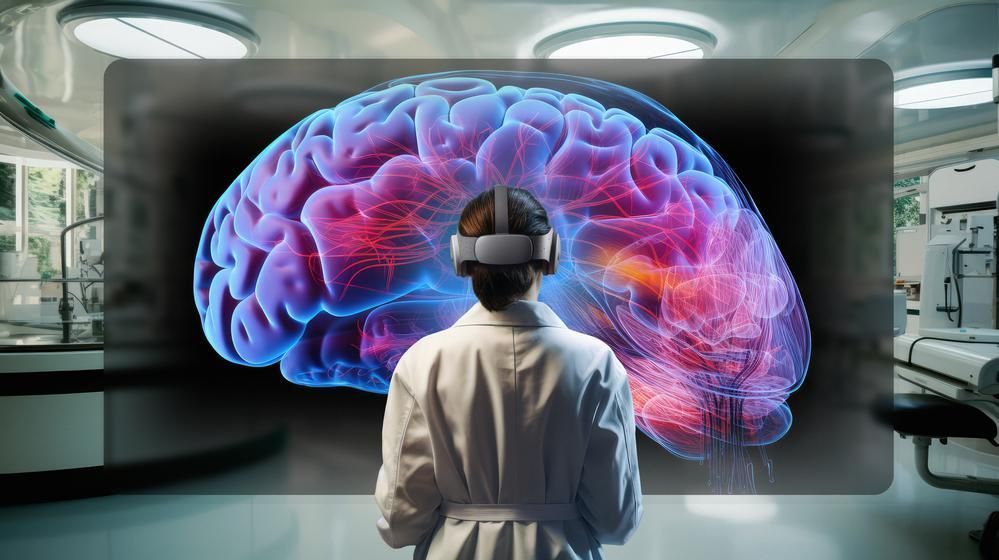
The brain surgery simulator is at the forefront of surgical training innovation as surgical simulation technology advances, unleashing new opportunities across healthcare, especially in neuroscience. In recent years, such advancements in clinical simulation have led to the completion of practical tests using highly advanced Neurosurgery Simulators. The development of such highly promising simulators has brought together both neuroscientists and software engineers, engaging in close collaboration to create greater training and education modules.
Examples of Neurosurgery Simulators
UpSurgeOn is an innovative healthcare simulation company headquartered in Italy, specializing in the development of hybrid and augmented reality-based platforms for neurosurgical and medical education. The company bridges the gap between theory and practice by providing interactive, immersive training tools that combine physical simulators with mobile and virtual reality applications.
Designed for students, residents, and surgical professionals, UpSurgeOn’s solutions promote safe, repeatable, and engaging hands-on practice in both preclinical and clinical environments. With a strong focus on cognitive and psychomotor skill development, UpSurgeOn enables learners to visualize, rehearse, and master complex neurosurgical procedures without the need for cadavers or clinical exposure. The company’s educational technologies have gained international attention for their portability, affordability, and ability to modernize surgical training curricula. Through intuitive digital and physical simulators, UpSurgeOn supports the global transformation of surgical education using evidence-based, technology-enhanced learning tools.
- NeurosurgeryBox: A portable brain surgery training simulator designed for psychomotor skills development and procedural practice.
Skull BaseBox: A high-fidelity simulation platform for skull base surgical approaches, combining 3D-printed models and AR-enhanced guidance.
CraniotomyBox: A tool for training in basic and advanced craniotomy techniques, with tactile feedback and realistic anatomical fidelity.
UpSurgeOn App: A suite of interactive mobile applications offering 3D anatomy exploration, surgical planning, and AR visualization tools. - Virtual Reality Neurosurgery Lab: An immersive VR platform that recreates a surgical environment for training cognitive and procedural skills in neurosurgery.
SurgeonsLab is a specialized medical technology company based in Germany, focused on advancing neurointerventional and endovascular training through high-fidelity surgical simulation platforms. With a mission to enhance clinical training and improve patient safety outcomes, SurgeonsLab offers state-of-the-art benchtop models and virtual reality solutions tailored to the complex demands of neurosurgical, radiological, and cardiovascular procedures. The company’s innovative simulators are designed to closely replicate real-life human anatomy and pathologies, enabling physicians, educators, and trainees to practice intricate procedures in a risk-free environment. With increasing emphasis on simulation-based education across global training institutions, SurgeonsLab stands out for dedication to realism, modularity, and evidence-based design. By providing cutting-edge simulation technologies, SurgeonsLab contributes significantly to advancing the standards of healthcare simulation and surgical skills development worldwide.
- NeuroCath Lab: A neurointerventional simulator with realistic vascular models for aneurysm coiling and stroke thrombectomy training.
- CardioCath Lab: A training system for cardiologists focused on catheter-based interventions, including coronary angioplasty and stenting.
- VesselVision: High-fidelity vascular models offering transparent anatomy for detailed visualization and device manipulation practice.
- PathoVasc Modules: Customizable modules simulating a wide range of vascular pathologies for specialized procedure training.
- HybridSim Lab: A modular hybrid simulator combining physical benchtop and digital components to enable immersive surgical training experiences.
NRC’s NeuroVR: NeuroVR replicates an open neurosurgical procedure, including the stereoscopic view and ergonomics of an operating room microscope. The simulator captures objective metrics on technique, performance, and completion time. With modules ranging from fundamental instrument handling to tumor resection and meningioma, NeuroVR allows self-directed practice in a risk-free environment, resulting in reduced medical errors and better patient outcomes. The NeuroVR features:
- Extensive range of exercises derived from actual patient images.
- User-friendly graphical interface with touchscreen.
- Adjustable ergonomic design.
- Switch between stereoscopic microscope view and 2D indirect endoscopic view.
- Realistic scope lens blurring and rinsing.
- Primary instrument set with realistic handles.
- Automatic recognition as you switch instruments during the exercise.
- Immediate and cumulative metrics to track proficiency goals.
- Performance feedback includes procedure duration, errors and instrument force.
The Evolution of Neurosurgical Simulators
Unveiled in the Department of Neurosurgery at Kepler University Hospital, Linz (Austria), one advanced brain surgery simulator in particular has received overwhelming approval from experienced neurosurgeons, according to Kepler University Hospital. As published in the International Journal World Neurosurgery, the Department of Neurosurgery at Kepler University Hospital in Linz developed a high-performance simulator with budding neurosurgeons in mind, and has since put its emerging medical simulator through expert testing.
Tested by experienced neurosurgeons with an average of over 14 years of neurosurgery experience, the medical simulator practical tests were based on data from actual operations. This led to the results of the simulated surgery being compared to the results of an actual surgery. Again, making sure that the brain surgery simulator closely mimics an actual surgery is imperative for true educational purposes.
The results of the brain surgery simulator testing at Kepler University Hospital showed that 89 percent of the neurosurgeons thought that the tool had improved their anatomical understanding. The results also made note that as many as 94 percent would have liked to see the simulator incorporated into neurosurgery education. Through these results the growing role simulation is able to play in surgical education has become increasingly apparent.
Pushing simulation innovation even further than some could have ever previously imagined, brain surgery simulators pave the way for a greater degree of realism through training than ever before. By using this tested simulation device, professionals and learners are able to simulate complicated brain surgery such as that recommended for dangerous bulges in arteries which are increasingly possible under realistic conditions.
View the new HealthySimulation.com Community Surgical Simulation Group to discuss this topic with your Global Healthcare Simulation peers!
As trainees can use the technology to manipulate real tools and instruments involved in neurosurgeries in real-time scenarios, they are thereby also able to encounter surgical instruments and arterial wall computations instantly. This helps match the chronology of a real operation. Remember, pilots are not the only ones who need to ensure that the tools of their trade provide pinpoint precision!
“In this way, surgeons can learn under realistic conditions,” Professor Andreas Gruber, Chairman of the Department of Neurosurgery, said. “This is absolutely essential for training and perfecting key skills, such as hand-eye coordination, depth perception and tactile discrimination.”
This brain surgery simulation tool has the potential to offer many major benefits with neurosurgery. For example, this technology provides Neurosurgeons with the ability to practice performing these often challenging procedures and operations before encountering a live patient. Not only does this build their confidence in performing each procedure, but also provides them with the ability to perfect their skills.
“This collaboration has, for the first time ever, enabled us to simulate arterial wall movement and real blood flow with a very high degree of realism. These two factors are crucial for successfully treating dangerous bulges in arteries known as aneurysms,” Prof. Andreas Gruber, Chairman of the Department of Neurosurgery, said. “While correct placement of the clips used to fix aneurysms is highly dependent on arterial wall movement, changes in blood flow are a crucial source of information about the success of the operation.”
Virtual Cerebral Aneurysm Clipping
An example of how this brain surgery simulator has been put to use involves the software system for virtual aneurysm surgery. Under development since 2012 in a joint project between the Department of Neurosurgery and the Institute for Neuroradiology at Kepler University Hospital, in cooperation with RISC Software GmbH, Hagenberg (Austria), virtual aneurysm surgery has proven largely successful throughout the early testing stages.
In the article, “Virtual Cerebral Aneurysm Clipping with Real-Time Haptic Force Feedback in Neurosurgical Education,” seven leading authors in the field of neuroscience (Matthias Gmeiner, Johannes Dirnberger, Wolfgang Fenz, Maria Gollwitzer, Gabriele Wurm, Johannes Trenkler and Andreas Gruber) further discuss the development of this patient-specific virtual aneurysm-clipping simulator with haptic force feedback and real-time deformation of the vessel.
To comprehensively assess the effectiveness of this product, virtual clipping was performed four patients with different medial cerebral artery aneurysms after real-life surgery. Then, the surgical results were compared regarding clip application, surgical trajectory and blood flow. Ultimately, this prototype simulator was evaluated by 18 neurosurgeons.
View the HealthySimulation.com Webinar Extended MX Reality in Brain Surgery: Addressing Current Problems with Innovative XR Technologies to learn more!
Integrating tried and tested innovation into its clinical practice has allowed trainees to achieve the greatest possible degree of realism while minimizing the required computing power. Special methods and algorithms combined with mart allocation of available processing power have contributed to a factual representation of arterial wall behavior.
Together, the authors’ illustrative cases demonstrated that virtual aneurysm surgery was possible using the same trajectory as in real-life cases. Both virtual clipping and blood flow simulation were realistic in broad-based but not calcified aneurysms. Furthermore, the virtual clipping of a calcified aneurysm proved that it could be performed using the same surgical trajectory, but not the same clip type.
Developing this technology required the close cooperation between software engineers and experienced neurosurgeons is necessary to incorporate software improvements, leading to realistic virtual simulations. Additionally, integrated into this particular software is the evaluation of the procedure by blood flow simulation.
Important to note, realistic, safe, and efficient modalities for simulation-based training are highly warranted to enhance the quality of surgical education. They should also be incorporated in resident training to ensure the utmost preparation of trainees. All in all, 94 percent of participants agreed that this simulator should be integrated into neurosurgical education.
This simulator also demonstrated an improved anatomic understanding for 89 percent of neurosurgeons. Simulation of head positioning and craniotomy was considered realistic by 89 percent and 94 percent of users, respectively.
The ultimate goal of brain surgery simulators, including simulations of aneurysm surgery, is that the technology be used for both education and training, as well as for pre-operative planning. Moving forward, the authors plan to prospectively evaluate their virtual aneurysm-clipping simulator device for surgical procedure planning and education. This validation of available neurosurgery simulation tools is the next step that will enable the training, acquisition and testing of neurosurgical skills.
Click Here to Connect to Leading Brain Surgery Simulation Vendors!