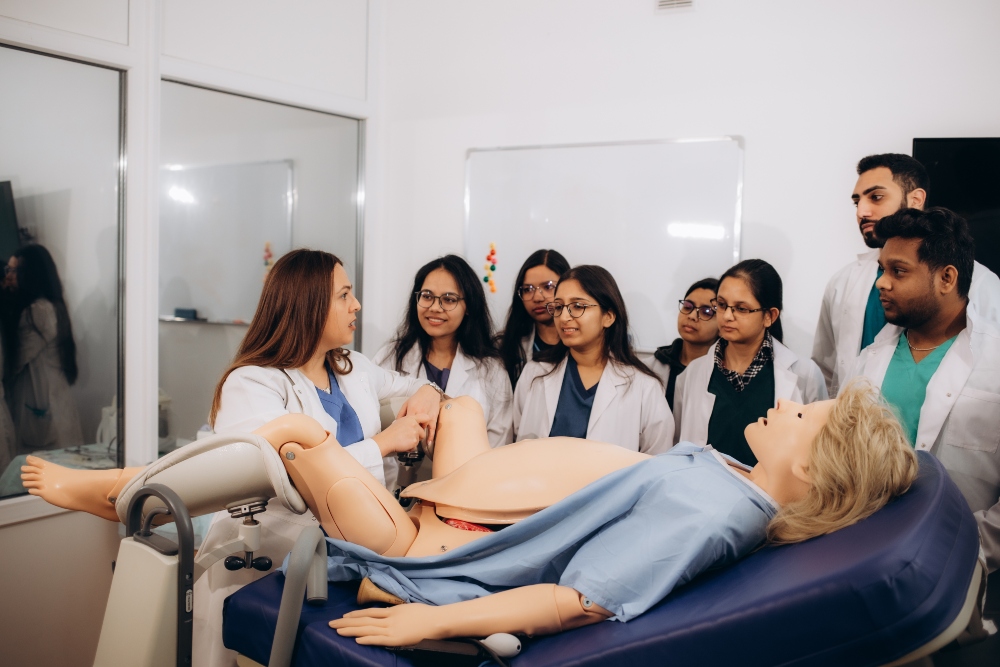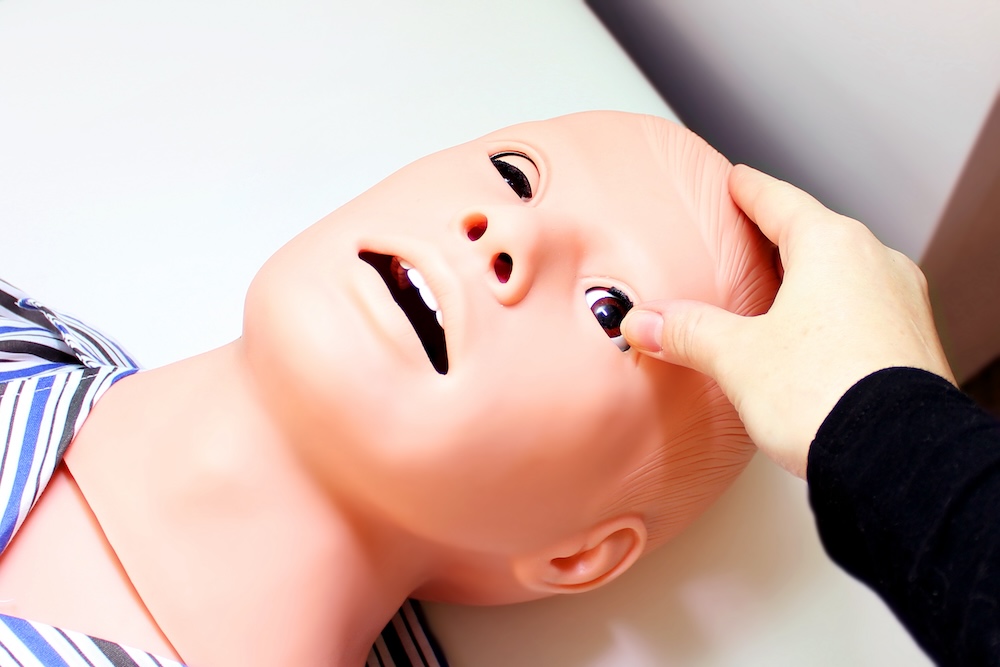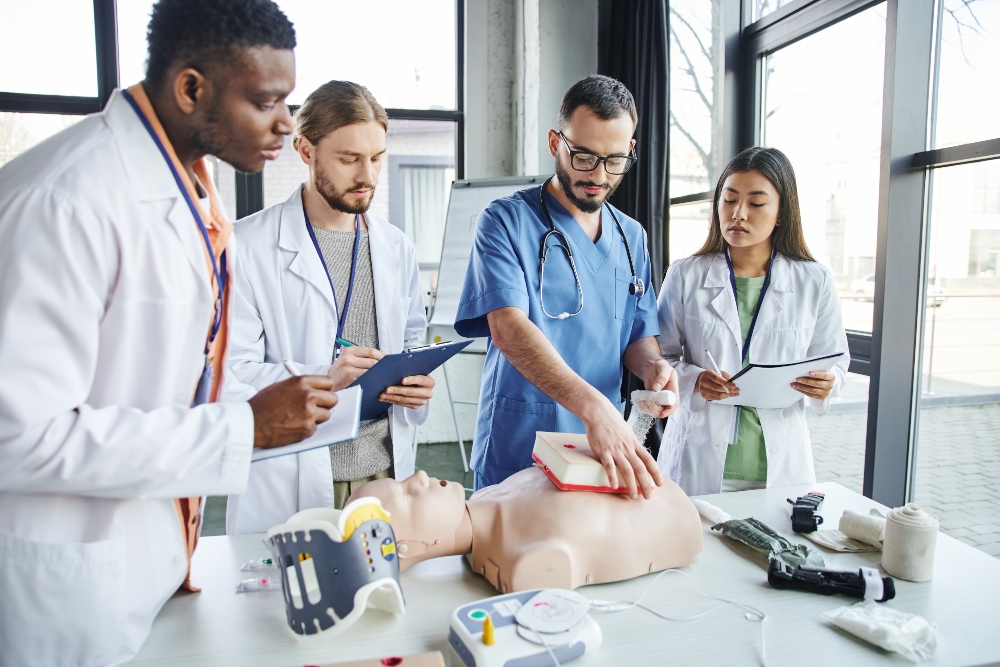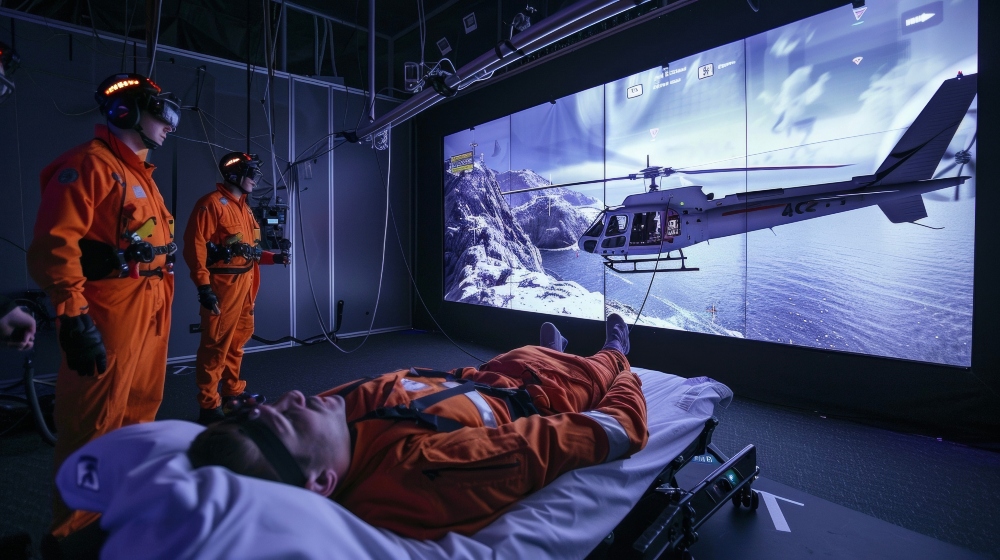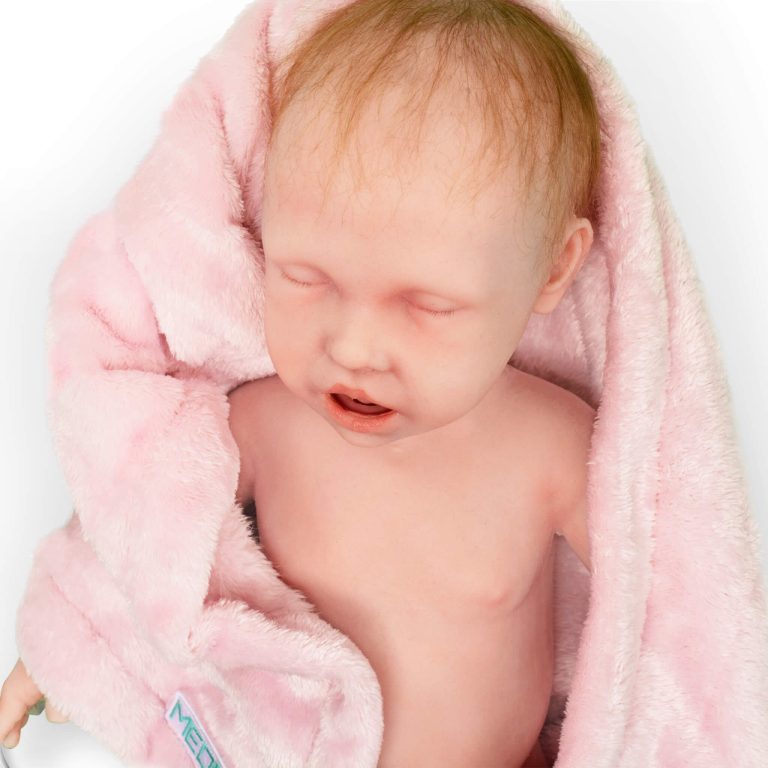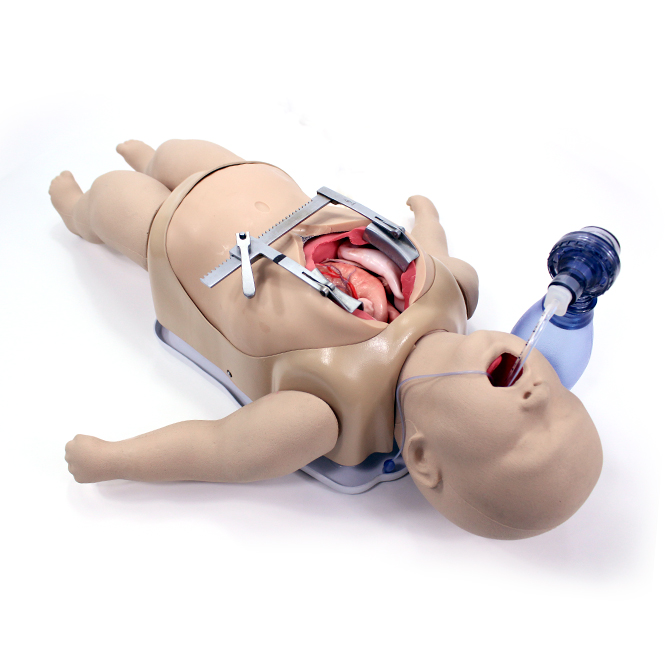

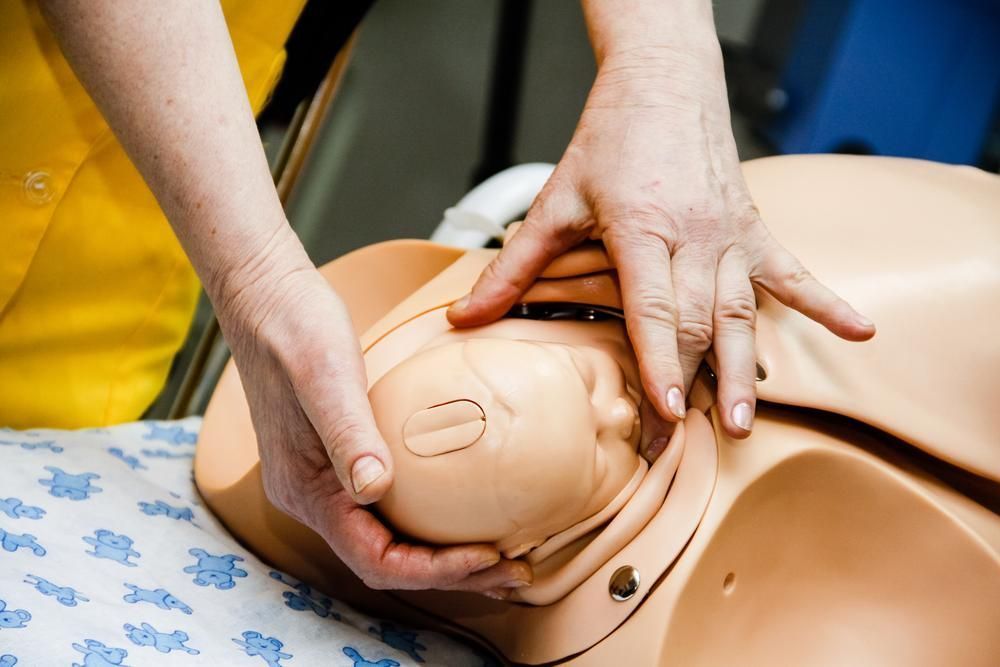
A birth simulator is a lifelike patient manikin, wearable birth simulator, birth skills training simulator, or virtual birth simulator that mimics a woman’s experience through labor and delivery which is used in healthcare simulation. Birth manikins are also known as a labor simulators, childbirth simulators or birthing simulators. The complexity of these unique patient simulators range from a simple static model, where the operator physically moves the baby through the birth canal, to a highly technical model which is fully automated and which can deliver a baby with differing configurations. Some birthing simulators come with a baby manikin which contains realistic characteristics such as cardiac and respiratory functions. Other manikins are wireless with no attached cables. This means the mother can deliver her baby in the most unexpected places! This article has been updated to go beyond stand alone simulators to also cover wearable birthing simulators and virtual birthing simulators as well.
With recognition of the benefits of flight simulation education in aviation, healthcare education has seen a huge expansion in the use of clinical simulation in all areas of medical education. Although simple childbirth simulators have been around for a number of years, the use of medical simulation in a simulation center, and in particular highly specialized birthing simulators, has increased significantly over the past 20 years. Manikins which more closely resemble and mimic human physiology are known as high fidelity manikins, which can even be used in surgery simulation.
Ranges of Healthcare Simulation Childbirth Simulators Vary
At one end of the scale, a basic birthing simulator may simply consist of a pelvis, birth canal, cervix and baby with interchangeable parts that allow learners to visualize some basic steps in the childbirth process, like for nursing simulation. At the other end of the scale, ultra-sophisticated manikins may contain a combination of any of the following advanced features for clinical simulation:
- Wireless remote control
- Streaming audio
- Either prerecorded or transmitted from an educator in another room
- Cardiac function
- Heart rates and rhythms that are audible and show up on a monitor
- Blood pressure (student can see BP on monitor or auscultate with cuff)
- Respiratory rise and fall of the chest
- Palpable pulses
- Dilating cervix
- Articulating joints
- Pupil dilation
- Accurate internal anatomy
- Palpable uterine contractions with monitor waveforms
- Oxygenation status of mother and baby.
- Fetal monitor with monitor display
- Newborn with heart rate, respiratory rate, umbilical cord, cyanosis
- Forceps application
- Vacuum extraction
- Variable passage of baby in birth canal – position can show on monitor
- Practice of episiotomies
- Complete or partial delivery of placenta
- Contracted or boggy uterus
- Anatomical holograms
- Practice of cesarean sections
- Postpartum hemorrhage with copious amounts of fake blood
- Simulate cardiac arrest of mother (or separate hi-fidelity manikin).
Advanced childbirth simulators are available from global corporations like Gaumard Scientific (Noelle, Victoria), Laerdal Medical (SimMom, MamaAnne, PROMPT, or MamaNatalie), and Elevate Healthcare (Lucina, LucinAR) just to name a few. Low and Mid-fidelity simulators are available from companies like Limbs & Things, Pocket Nurse, and more. If you cannot wait until annual healthcare simulation conferences like INACSL, IMSH (from SSH), or SimGHOSTS, use our “find vendor” form to connect with leading vendors now! There are also varying levels of high-fidelity patient manikins in the categories of pediatric simulators and infant simulators too.
According to the US Census Bureau, in 2017 infant mortality rates ranged between 2.3 to 180 infant deaths per 1000 deliveries worldwide. In the United States the rate was 6.2 (ranking 56). Across the globe, even in developed countries, a surprising number of women die each year from conditions associated with childbirth. The World Health Organization (WHO) states that maternal deaths occur nearly every two minutes, which results in over a quarter million mothers dying a year. Maternal mortality rates are on the rise, especially in the Americas and Europe when considering racial disparities. Four out of five pregnancy-related deaths are preventable.
View the new HealthySimulation.com Community OB Birthing Simulation Group to discuss this topic with your Global Healthcare Simulation peers!
Healthcare simulation provides an opportunity for individual healthcare members and teams to practice care of a mother and her newborn without any risk of harm to a mother or baby. Many birth manikins are controlled remotely by a technician with input from an educator, who apply special effects makeup called moulage to make the simulated experience as real as possible. This allows learners to practice making independent decisions in a variety of real life situations.
Childbirth simulators can mimic labor problems, high risk deliveries and postpartum emergencies. For example, birth simulators can mimic the woman who labors for hours or who has comorbidities such as diabetes or high blood pressure (eclampsia). Delivery can be programmed to present with complications such shoulder dystocia (when the baby’s shoulder becomes stuck on the mother’s pubic bone), babies with low Apgar scores and placenta abnormalities.
View the HealthySimulation.com Webinar High Quality Healthcare Simulation: How to Get Started! to learn more!
Life threatening postpartum conditions such as hemorrhage or cardiac arrest can also be simulated. Many potentially serious events associated with childbirth may not occur very often and therefore, staff get little chance to become efficient in responding to such emergencies. Clinical simulation provides that opportunity and allows obstetricians, midwives, nurses and other healthcare personnel to practice critical events and save lives. These childbirth simulators also provide real life experiences for teams to practice communication and team interactions. Failure to communicate is one of the leading causes of medical errors.
The choice of birth manikin is determined by the learning outcomes and learner level. Not every hospital or healthcare educational institution needs one of the high-end manikins nor can they afford the tens of thousands of dollars that the manikins cost. For example, associate degree nursing programs barely touch upon obstetrics and in these cases less expensive and simpler models can work very well to mimic childbirth and delivery. Birthing manikins provide the technology but the educational theory and methodology should be the foundation and primary focus of any simulation program.
Low Fidelity Birth Simulators
Laerdal MamaBirthie is a low fidelity and low cost wearable simulator and task trainer for multiple birth scenarios as well as being a skills trainer. MamaBirthie enables healthcare professionals to be able to refine their clinical skills through simulated normal births, vaginal exams and more complex birth scenarios such as breech, shoulder dystocia, vacuum assisted, and forceps assisted births. MamaBirthie births BabyBirthie, which is a realistic low fidelity newborn simulator.
Laerdal MamaBirthie is able to conduct thousands or more low dose yet high frequency clinical simulation scenarios for many participants effectively. Laerdal MamaBirthie is able to accommodate various birth positions. MamaBirthie can be worn by a standardized patient or used as a tabletop skills-trainer. BabyBirthie is a realistic articulated newborn manikin with a soft head, fontanels and anatomical important landmarks to identify breech and shoulder birth presentations.
Laerdal MamaNatalie is also a low fidelity birth simulator with high impact. MamaNatalie is a low cost way to deliver high impact in an obstetric simulation program. In a randomized controlled trial of birth simulation for medical students, MamaNatalie was found to be as effective to train medical students on how to perform a vaginal delivery as a high fidelity birth simulator.
MamaNatalie allows learners to be educated on normal delivery, postpartum complications and neonatal resuscitation. NeoNatalie is the included newborn simulator which allows the healthcare simulation participants to be able to practice newborn care and resuscitation. NeoNatalie allows clinical simulation participants to practice and refine newborn resuscitation and perform bag mask ventilation. NeoNatalie demonstrates chest rise with correct bag mask ventilation technique. The facilitator can use the provided squeeze bulbs to simulate birth cries, spontaneous breaths, palpable umbilical pulse and the auscultation of heart sounds.
High Fidelity Birth Simulators
Nasco Lucy Maternal and Neonatal Birthing Simulator is a clinical simulation system designed to present the complex clinical needs of mothers in pregnancy and birth. Lucy creates physical realism and enhances immersion in the healthcare simulation scenarios. Lucy is designed to provide comprehensive and economical birth experiences from prenatal to postnatal delivery scenarios.
Nasco Lucy allows clinical simulation participants to be able to experience high fidelity normal and abnormal deliveries. The simple design of Lucy makes this birth simulator easy to use while teaching birth techniques for all levels of healthcare simulation birth simulation. Lucy has the ability to receive airway management and CPR in clinical simulation scenarios. She can also demonstrate a number of birth related presentations such as: cervical dilation, different delivery methods, articulating baby and hemorrhages.
Gaumard Victoria is able to provide a high fidelity birth simulation experience from early pregnancy complications, high-risk deliveries, and postpartum emergencies to birth related scenarios for general nursing care. Gaumard’s Victoria simulates a full range of obstetrical events to facilitate teamwork and deepen critical thinking skills in learners of all levels. Victoria is a complete birth simulation solution developed from decades of obstetrical experience.
Gaumard Victoria has a programmable airway, breathing, and circulation physiological parameters. Victoria also is able to simulate shoulder dystocia, breech, and c-section deliveries. Victoria births a full term baby and has programmable vitals for APGAR scores. Victoria includes 9 labor and delivery simulation learning experiences and also converts into a non pregnant patient for general nursing and gynecology simulation based education.
Gaumard Noelle is a maternal care simulator with OMNI. The Noelle provides learners with a complete birth simulation experience. Healthcare simulation participants can provide care before, during, and after delivery. The Noelle simulator provides capabilities in ALS, obstetrics, and neonatal resuscitation protocols. Noelle has multiple fetal heart sounds that can be heard through a normal stethoscope. The Noelle resuscitation baby has an intubatable airway and patent umbilical vein.
Laerdal has released MamaAnne, a maternal birth simulator, in 2024. MamaAnne aims to provide quality healthcare education to address the increasing maternal mortality rates. MamaAnne offers healthcare professional learners the opportunity to practice obstetric events to improve maternal outcomes. MamaAnne is a solution for clinical educators and learners to practice focused and efficient clinical simulation education to reduce occurrence of adverse obstetric events.
High-fidelity clinical simulation builds confidence and competence when facing critical, obstetric emergencies. MamaAnne, provides the platform for obstetric training through simplified configuration for rapid use, a reinvented automatic delivery system, and flexible solutions to adapt the scenario and meet competency requirements for evidence-based practice and better maternal outcomes.
MamaAnne allows clinical educators the ability to run their scenarios their way. The modular components are a foundational pillar of MamaAnne’s design. Modular options allow for flexible bleeding solutions and interchangeable modules. An example of MamaAnne’s flexibility is with the Post-Partum Hemorrhage (PPH) scenario options. The PPH clinical simulation scenarios can be simulated using different methods. Some examples of these include: internal bleeding uterus which requires fluids, clean bleed mat for a seamless transition from birth to bleeding and easy clean-up, 1.5L internal and 5.0L external blood tanks to meet volume requirements of PPH scenarios.
Wearable Simulators Add Level of Patient Realism
Simulation programs looking to better demonstrate the complexities of maternal care during pregnancy should also consider investing in wearable birth simulators, like those available from Avkin. These unique wearable labor simulators can be worn by a Standardized Patient, aka Simulated Patient, who will act out the patient experience while the infant is being born. Unlike a manikin which is usually quite an emotionless representative of the maternal patient, working with a professionally trained actor can increase the stress on learners to perform complicated clinical birthing patient care while interacting with a person responding in real time.
Avkin’s Avbirth has become a maternal-fetal “game-changer for this level of increased realism as the technological advancements, wearable design, and pre-programmed simulations set this technology apart. The tetherless wearable birthing simulator has been designed to authentically simulate all stages of childbirth, mimic the physiology of the birthing process, and provide cues to the “mother” during contractions via haptic vibrations. Avbirth can also prepare clinicians for how to handle emergencies and has the ability to replicate obstetrical emergencies commonly encountered in marginalized populations.
The “simulated mother” can ambulate untethered during early labor, promoting dilation, and effacement as they transition to active labor. Learners can now realistically practice coaching through a contraction because the mother and support person can both receive haptic signals at the wrist that follow the ebb and flow of the contraction.
Virtual Birth Simulators Add Online 24/7 Training Opportunities
Finally, in the more contemporary present is the ability to train OB clinical tasks through the use of virtual birth simulators, like those available from Virtual Medical Coaching’s with their newest Childbirth and Midwifery Solution, which is now readily available to Universities and Colleges on campus and remote learners with access to Virtual Reality (VR) equipment and soon-to-remote learners on their Desktop computers.
Faculty can observe and critique students during the VR simulations or the student can work independently to improve their clinical practice. The opportunity to receive direct instantaneous and objective feedback is always welcomed by the students and faculty. The use of VR simulation in conjunction with adaptive learning and big data analytics in skills training for the midwifery and nursing students increases students’ performance in effectively managing maternal and neonatal care in labs.
VR-based simulation provides students with a fully immersive environment where they can perform diagnostic assessments during childbirth, observe internal and external rotations, understand the mechanisms of labor, identify fetal positions, and monitor restitutions to help ensure a smooth delivery process.