
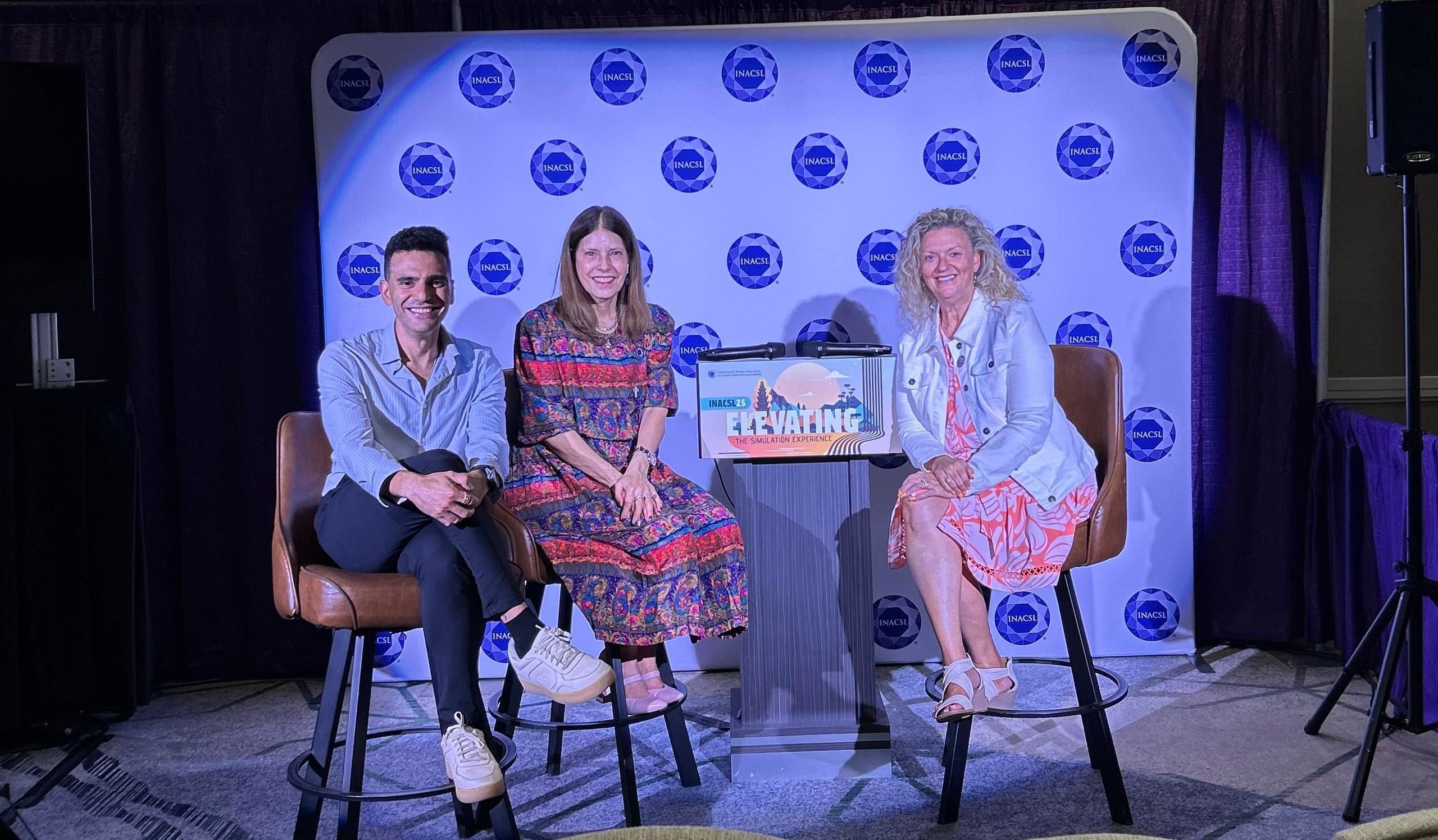
The International Nursing Association for Clinical Simulation and Nursing (INACSL) 2025 conference in Denver, Colorado, served as a crucial platform to disseminate advancements and strategies developed by healthcare simulationists. INACSL has dedicated committees and special interest groups (SIGs) to carry this important work. Dr. Teresa Gore, Content Manager for HealthySimulation.com and a past INACSL president, conducted a series of insightful interviews detailing the operational goals and key accomplishments of these groups. These discussions revealed a community focused on rigorous research, robust standards, and collaborative innovation in healthcare simulation.
INACSL Drives Healthcare Simulation Research and Publication Excellence
A major pillar that supports simulation science is the Clinical Simulation in Nursing journal, the official journal of INACSL. Editor-in-Chief Lisa McKenna noted the journal’s recent exponential growth, evidenced by a significant increase in high-quality manuscripts and a prestigious ranking of 11th among nursing journals. The journal is increasingly seeing submissions from health professionals outside of nursing, indicating its expanding interprofessional reach. Current publication trends reflect the community’s engagement with cutting-edge technology, particularly virtual reality (VR) and artificial intelligence (AI), which prompted a special issue dedicated to AI this year. The journal is online provides members with access to an archive of past articles, and the editorial team is actively working to reduce turnaround times.
To support healthcare simulation research, the Deb Spunt Grant awarded by INACSL acts as critical seed money for new researchers. Named for INACSL co-founding president Deborah Spunt, the grant awards two $1,000 awards annually, sponsored by Laerdal, to support projects that align with INACSL’s mission. The grant is designed to nurture future simulation researchers, providing recipients, who do not need to be proven researchers, with essential experience in grant management and data analysis. The committee emphasizes that the application process is open to quality improvement and evidence-based practice projects and is not limited to those with PhD-level research rigor.
View the new HealthySimulation.com Community Nursing Simulation Group to discuss this topic with your Global Healthcare Simulation peers!
INACSL Advancing Quality and the Healthcare Simulation Standards of Best Practice (HSSOBP)
The INACSL Standards Committee detailed the rigorous process of updating the Healthcare Simulation Standards of Best Practice, which moved to an interprofessional focus in 2021. The Core Four foundational standards (Professional Integrity, Preparation/Briefing, Facilitation, and Debriefing) underwent comprehensive research reviews, which included a systematic review for three standards and an umbrella review of 16 systematic reviews for debriefing. The key finding across all reviews confirmed that the standards are strongly supported by research, but highlighted a major gap: the need for consistent definition and operationalization of terms, such as training, in simulation research literature. The updated Core Four standards are anticipated for publication in August 2025, and adherence to these standards is essential for maximizing learner outcomes across all disciplines.
For institutions that seek external validation, the Endorsement Committee confirmed that 54 centers globally are currently endorsed by INACSL. The endorsement process, which focuses on adherence to the four core cornerstones of best practice (Professional Integrity, Pre-briefing, Facilitation, and Debriefing), holds programs accountable for maintaining high-quality, consistent simulation delivery. Early cycles of the endorsement process revealed that many programs struggled to document the purposeful integration of Diversity, Equity, and Inclusion (DEI) within their simulations, demonstrating a need for clarity beyond institutional policy.
To aid educators in the application of the HSSOBP, the International Simulation Education Program (ISEP Program) offers a 100% online, six-month curriculum where participants develop a simulation while mastering the INACSL standards. A key feature is the pairing of participants with expert facilitators who provide one-on-one coaching, feedback, and validation and ensure the simulation design is aligned with best practices.
INACSL’s Focused Initiatives: Inclusion, Regulation, and Innovation
Two crucial committees, Research and Inclusion, demonstrated cooperative efforts to advance quality. The Research Committee is dedicated to updating the INACSL Instrument Repository, to ensure that simulation researchers have access to reliable and valid measurement tools. Meanwhile, the INCLUDE (Inclusion, Diversity, Equity) Committee, founded in 2020, is pursuing the goal to develop a dedicated DEI standard. A major project underway is the creation of a DEI rubric to help faculty meaningfully integrate inclusive excellence into scenario development, a tool the Research Committee will ultimately house in the repository.
For healthcare simulationists concerned with external policy, the Simulation Regulation Map provides a vital resource. This map, compiled by the Regulatory Initiatives subcommittee, tracks simulation regulations across the 50 US states, territories, and Canada. The committee’s deep-dive research identified that many regions have increased the maximum percentage of simulation allowed toward direct clinical hours to 50%. The dynamic map is essential for self-calibration and for advocating for program growth with institutional leadership.
Finally, the interviews highlighted the crucial role of collaborative problem-solving through Homegrown Solutions and Specialty Groups (SIGs). Homegrown Solutions, a committee partnered with NLN, manages a website featuring over 99 peer-reviewed solutions—low-cost, self-made hacks—that are freely accessible to the simulation community. Submissions are peer-reviewed and encouraged to include videos for replication.
Within the SIGs, the Virtual SIG helps members stay abreast of rapidly evolving VR and AI technologies by facilitating resource sharing and technical insights. The Sustainability SIG addresses the substantial material waste in healthcare by advocating for the “five Rs” (recycling, reuse, repurposing), educating students, and providing practical tips, such as using VR as a method to decrease waste and costs.
The collective work presented at INACSL 2025 underscores INACSL’s role as the central hub for professional development and the advancement of simulation science, to foster an environment where members are continually encouraged to engage, review, mentor, and innovate.
Learn More About INACSL: International Nursing Association for Clinical