
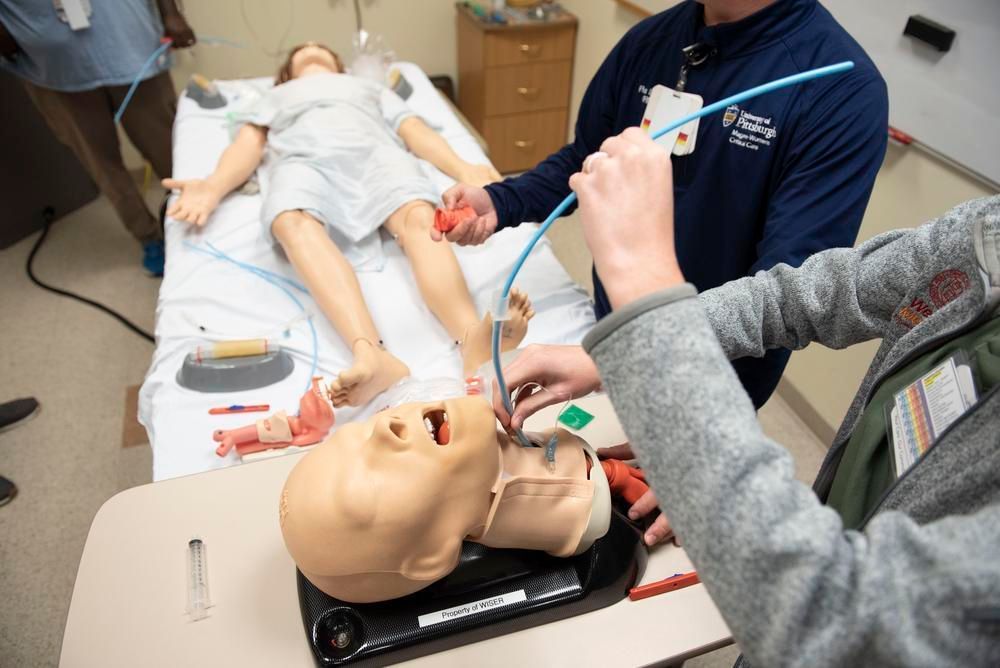
Serving both the University of Pittsburgh and the UPMC health system, the Winter Institute for Simulation, Education, and Research (WISER) is no stranger to the wide range of demands simulation is often tasked with satisfying. Fully accredited by the Society for Simulation in Healthcare (SSH) in Teaching/Education, Assessment, Research, Systems Integrations, and Fellowship Programs, WISER is dedicated to the improvement of the quality and efficiency of healthcare delivery with the creation of innovative programs geared towards patient care outcomes improvement while simultaneously providing professional development opportunities for those interested in improving their skillset as simulationists. This HealthySimulation.com article highlights some of the classes and training opportunities offered by WISER that are a direct reflection of patient safety initiatives. Additionally, this article details WISER’s upcoming Improving Simulation Instructional Methods (iSIM) course, which provides participants with all the foundational knowledge and skills needed to create and deliver effective simulation-based healthcare training programs.
University of Pittsburgh (UPMC) and Winter Institute for Simulation, Education and Research (WISER)
The expertise required to deliver effective simulation-based healthcare education and training that focuses on the direct improvement in patient care outcomes cannot be overstated. Facilitators and instructors often utilize simulation to teach diverse learners, that ranges from nursing or medical students to practicing professionals. Simulation sessions may be tailored to specific fields, like obstetrics and intensive care, or involve multidisciplinary participants for team training events, such as in-situ simulation. This feat not only requires instructors and facilitators to be familiar with the various equipment and simulators needed to run scenarios, but also the skills and knowledge necessary to design, develop, deploy, and debrief the entire healthcare simulation session.
The development of clinical simulation professionals within the field of healthcare simulation can be a challenge for any institution. The Winter Institute for Simulation, Education, and Research (WISER) provides unique opportunities to overcome these challenges in effective ways through their WISER Academy courses. Directed by Paul Phrampus, MD, CPE, FSSH, the WISER Institute features instructional technologies and methods to develop innovative healthcare education programs that ultimately aim to improve the welfare and safety of the general public.
WISER Emphasizes Patient Safety Initiatives
WISER’s in-situ mock code initiatives bring high-stakes simulations directly to the bedside to uncover and report latent safety threats in a real care setting. Through the Inpatient Crisis Response System Evaluation program, a collaborative effort with several UPMC member hospitals, WISER partners with safety and unit leaders to design tailored scenarios that challenge floor staff and rapid response teams. After each on-site assessment of the systems in place to support patients who experience unexpected deterioration, WISER provides a comprehensive report that highlights system vulnerabilities identified through the mock code and opportunities for targeted education to prevent patient harm.
Similarly, the ICU Crisis Response Training Program uses high-fidelity mock code crises modeled specifically for intensive care settings. Participants of this course engage in realistic simulations, then receive structured debriefing and direct performance feedback aimed to strengthening teamwork, clinical decision-making, and crisis resource management. By embedding these mock codes directly into patient care units, WISER improves individual and team performances while promoting system-wide learning that ensures best practices in crisis response reach across the health system.
View the HealthySimulation.com Webinar Increase Simulation Program Efficiency with the SIMS Management Tool to learn more!
Healthcare Simulation to Keep Care Team Members Up-to-Date with Changes
To ensure every member of the care team remains up-to-date with various protocols and procedures, WISER supports a variety of courses grounded in clinical simulation-based verification that offer opportunities for deliberate practice. Competency Day, a joint effort with UPMC, provides annual, scenario-driven assessments for nursing, OR, ED, and support staff. Course content is annually updated to reflect evolving educational needs, covering topics ranging from diabetes management to fall-prevention strategies, and verifying every staff member delivers consistent, high-quality care. The Introduction to Peripheral Nerve Blockade course, designed for incoming anesthesiology interns, combines didactic sessions on the indications and contraindications with a four-hour workshop that allows interns to hone live-scanning techniques on standardized patients. This blend of cognitive and technical practice ensures providers develop confidence and competence before performing procedures on live patients.
Airway security is fundamental to patient safety, and WISER’s targeted airway management courses ensure providers at every level achieve mastery in these critical skills. The Cricothyrotomy Training for Anesthesia Residents workshop teaches this rare but life-saving procedure through immersive scenarios in which residents demonstrate mastery of the knowledge and hands-on technique to establish the airway. Recognizing the unique challenges of neonatal airway care, the Neonatal Resuscitation Program, created in partnership with the American Academy of Pediatrics, integrates simulation-based drills with focused training on technical, cognitive, and communication skills to optimize teamwork during newborn resuscitation.
For advanced practice providers new to intensive care, the Difficult Airway Management for Advanced Practice Providers course presents an algorithmic approach for both anticipated and unanticipated airway challenges in the critical care setting. Blending fundamental didactic knowledge on airway evaluation with complex airway scenarios, WISER reinforces their commitment to patient safety at every breath.\
View the new HealthySimulation.com Community Simulation Technology Specialists Group to discuss this topic with your Global Healthcare Simulation peers!
Advance Your Simulation Creation Skills with WISER’s iSIM Course!
Learn how to create courses that directly impact patient safety outcomes with WISER’s iSIM course! Created for educators, practicing professionals, and novice simulationists, with the next iSIM two-day course running from June 11-12, 2025 (but more dates after that), which teaches participants all the foundational knowledge needed to effectively design, develop, deploy, and debrief simulation scenarios. Created in collaboration with the Gordon Center for Research and Medical Education, iSIM provides an in-depth overview of curriculum integration, equipment selection, learner assessment, active facilitation, and the GAS model of debriefing to build confidence and competence for those who may be new to the world of simulation.
The course begins with foundational principles of curriculum mapping and identifying learning objectives for a variety of learners while aligning appropriate simulation technology, like task trainers, standardized patients, or high-fidelity manikins, to learning outcomes. Through short, interactive lectures and facilitated discussions, iSIM teaches participants how to organize learning activities, establish clear evaluation criteria, and ensure psychological safety for learners. Attendees are then grouped together to create and pilot their own scenarios with the guidance and advice of the expert simulationists at WISER.
These test runs allow for the identification of technical issues, timing challenges, and proper facilitation interventions. Tom Dongilli, Director of Operations at WISER and past instructor of iSIM, shares, “If you are not comfortable designing simulations for multiple modalities, if you’re not comfortable facilitating a simulation session, if you’re not comfortable creating assessments for a simulation session, if you’re not comfortable debriefing a simulation session, iSIM is a great course to get you comfortable doing that.”
The ability to know how to create courses that have a direct impact on patient care outcomes is vital for educators and simulationists tasked with the creation of simulation-based healthcare training programs. For more information and to register for WISER’s upcoming iSIM course running available at multiple dates in the future, follow the link below: