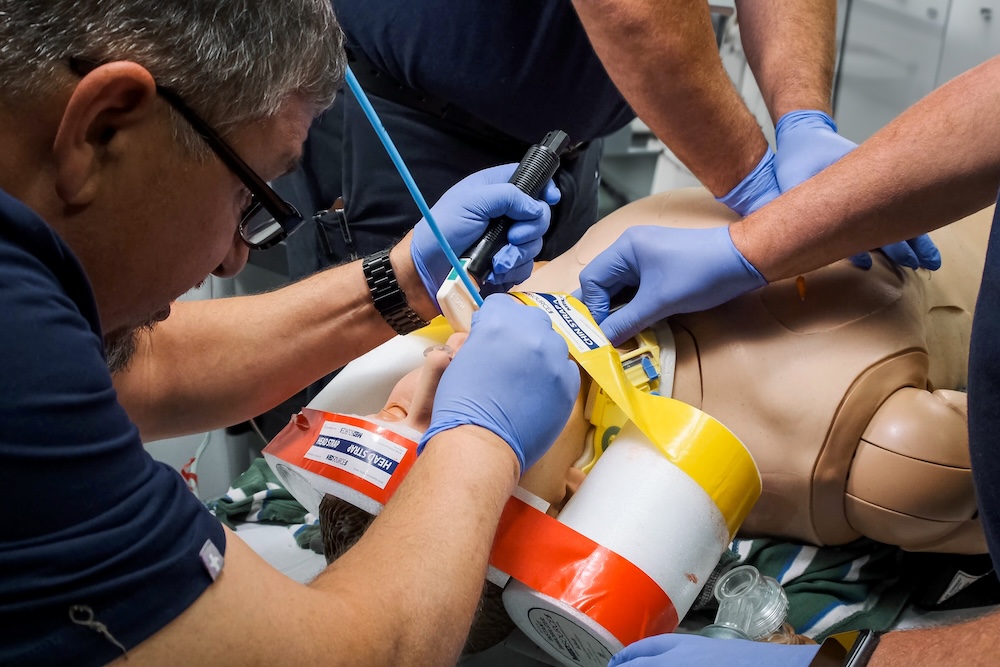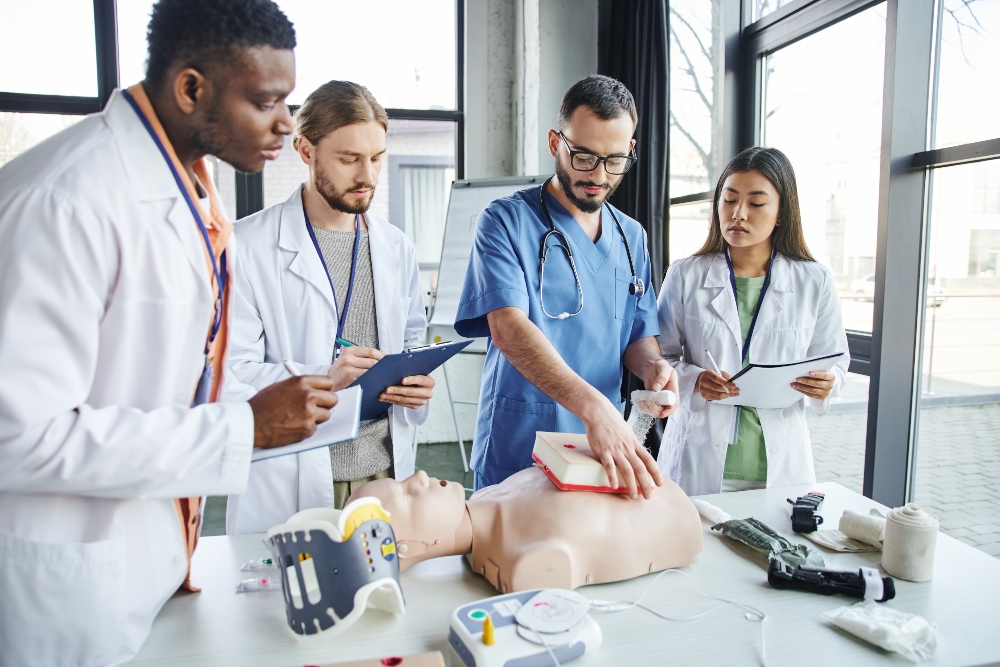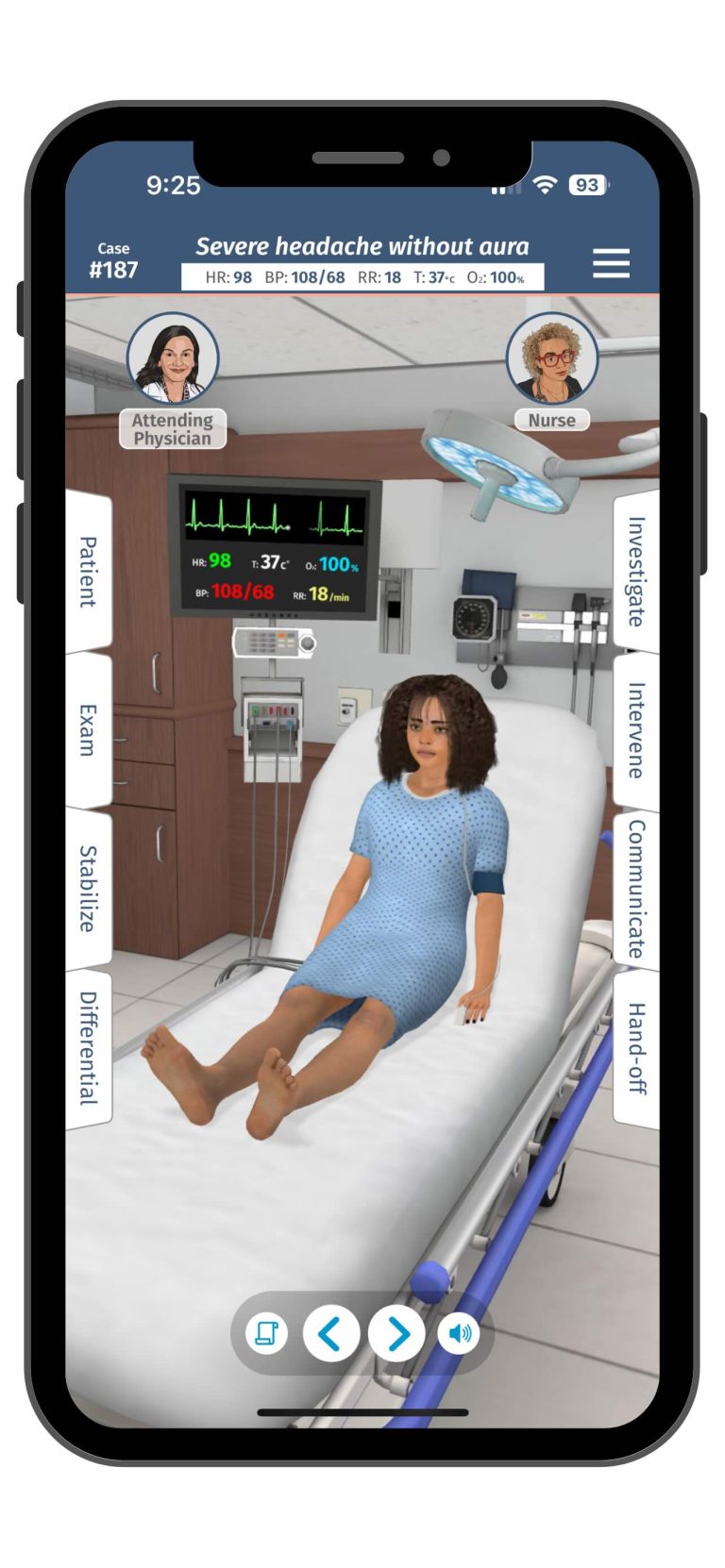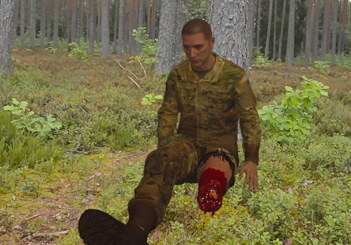

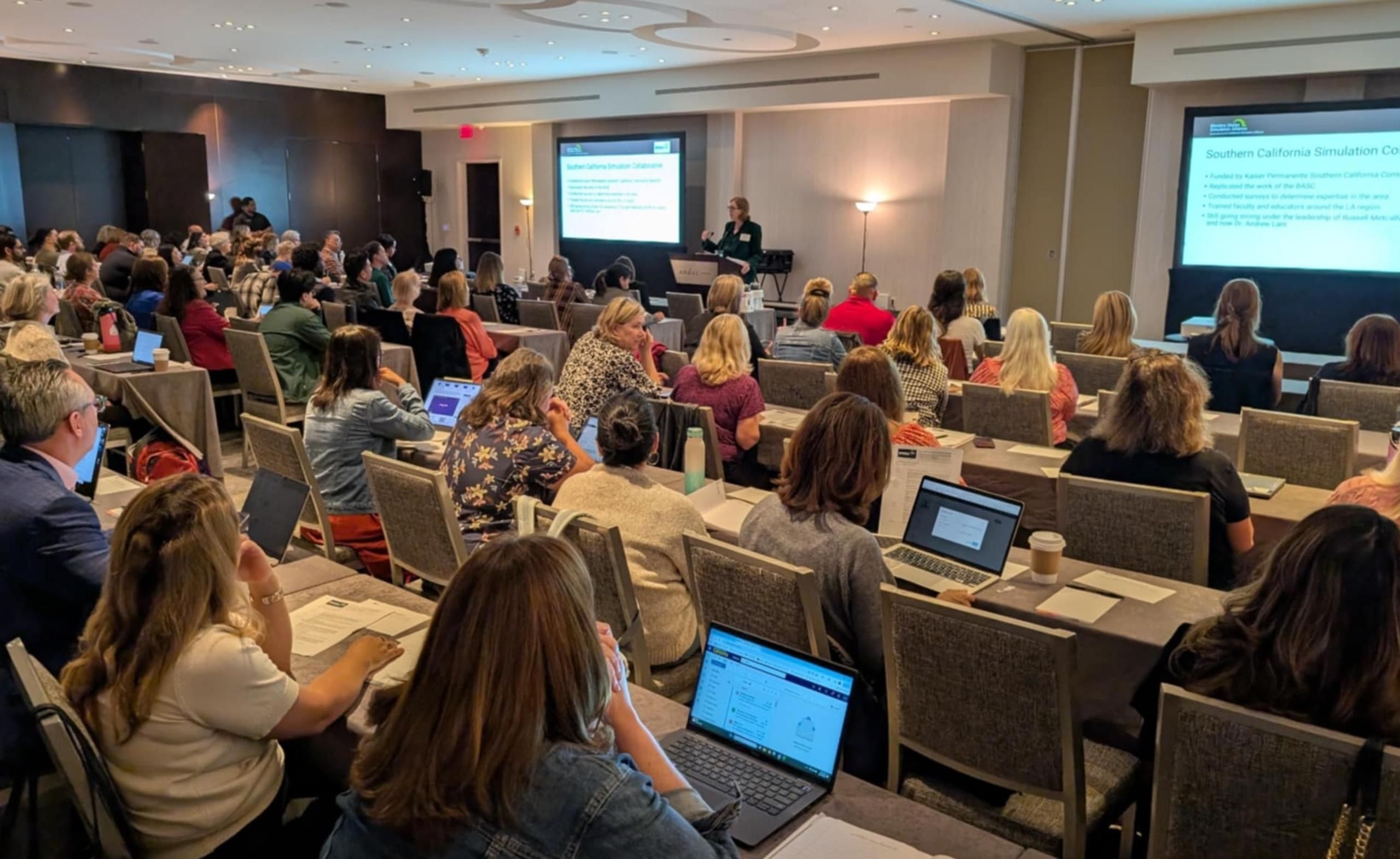
Last week the inaugural event for the Western States Simulation Alliance (WSSA) took place in San Diego, California. Formerly known as the California Simulation Alliance, under the tireless leadership of Dr. KT Waxman, the non-profit organization has expanded to include 7 regional medical simulation collaboratives from across the Western United States, including Alaska, Washington, Oregon, Idaho, Montana, California, and Hawaii. Hundreds of healthcare simulation champions connected over two days to learn from leading experts, connect with peers, and view the latest simulated learning training technologies from top vendors such as Medical Shipment and Laerdal Medical. As a proud media sponsor, HealthySimulation.com’s Founder/CEO Lance Baily attended the event to capture the excitement of WSSA San Diego 2025!
This year’s WSSA conference theme was BRIDGES “Building Relationships, Innovation, Development, and Growth Excellence in Simulation”. Opened by HealthImpact President & CEO Garrett Chan, PhD, RN, APRN, FAEN, FPCN, FNAP, FCNS, FAANP, and WSSA Director and Professor at UCSF School of Nursing KT Waxman, DNP, MBA, RN, CNL, CHSE, CENP, FAONL, FSSH, FAAN, the duo provided a brief historical overview of how the WSSA came to be. With a mission to strengthen expertise in healthcare simulation and advocate for simulation policy through interprofessional education, collaboration, and evidence-based practice and a vision to strengthen the healthcare workforce through high-quality clinical simulation, the goals of the NPO include:
- Conduct educational simulation courses
- Share best practice models
- Curriculum integration in both hospitals and schools
- Conduct inter-organizational research
- Negotiate contracts with vendors for pricing agreements and sponsorships
- Be the “voice” for simulation with the Boards of Nursing in the Western States
- Be a consultant for new programs
The California Simulation Alliance (CSA) was established in 2008 as a statewide consortium dedicated to advancing simulation-based education. Over time, the CSA developed eight Regional Collaboratives, each focused on strengthening local simulation capacity and expertise. The primary goal was to train regional trainers within each collaborative to build sustainable, high-quality simulation programs across California. The CSA has maintained a self-sustaining model since its inception, supported through diverse revenue sources including course fees, consulting services, and sponsorships.
The not-for-profit organization received two grants from Kaiser Permanente Northern California Community Benefits to support Implicit Bias Scenario Development, expanding the scope and impact of its educational initiatives. Building upon this strong foundation, the CSA evolved into the Western States Simulation Alliance (WSSA), a broader, multi-state collaboration uniting healthcare simulation leaders across the western United States.
View the HealthySimulation.com Webinar by Dr. Waxman on How to Expand a Regional Healthcare Simulation Collaborative to learn more!
Dr. Arnold Morning Keynote on Advancing Patient Safety Through Healthcare Simulation
Dr. Jennifer Arnold, MD, MSc, FAAP, Program Director of the Immersive Design Systems (IDS) at Boston Children’s Hospital, and Physician Leader at Harvard Medical School, presented an overview of the historical path healthcare simulation has taken to advance as a patient safety and quality improvement tool. The presentation traced how healthcare simulation practices evolved from basic training methods to essential components of modern clinical education and system improvement.
Dr. Arnold discussed five distinct applications of healthcare simulation that have been used to enhance patient safety in clinical environments, including team communication, crisis management, system testing, process improvement, and human factors analysis. She also differentiated between clinician-focused and patient-centered applications of healthcare simulation for patient safety, emphasizing how each approach contributed to improved performance, collaboration, and patient outcomes.
Dr. Arnold reminded us that as opposed to work as imagined, abstracted, observed, documented, or claimed, medical simulation can best mimic work as done. She continued with examples of key best practices and tools such as SIMProtect, a framework for Applying simulated healthcare as a patient safety tool which can support the:
- Application of healthcare simulation as a tool to improve patient safety.
- Creation of a strategic partnership based on shared goals between patient safety and simulation.
- Implementation of healthcare simulation methodology based on specific safety goals.
When asked how to encourage administrators to invest in medical simulation, Dr. Arnold recommended having your elevator pitch ready, sharing impactful stories demonstrating how simulation programs can work, and finally of never being afraid to reach out to leaders and let them know about the opportunities of this emerging technology!
Find Healthcare Simulation Collaboratives in Your U.S. State or Globally Around the World!
Dr. Jared Kutzin Afternoon Keynote on Getting Started with Clinical Simulation
Jared Kutzin, DNP, PhD, MS, MPH, FSSH, FAAN, Senior Director of the Simulation Teaching and Research (STAR) Center at The Mount Sinai Hospital and President Society for Simulation in Healthcare (SSH), provided the afternoon keynote where he shared about the Non-Profit Organization and its many resources.
Reminiscing on his recent travels to Nepal and India, Dr. Kutzin reminded us the problems of getting started with clinical simulation are the same around the world: how do we get funding, how do we get the equipment, and how do we do this? He reminded the audience that it does not take a whole lot of fidelity in-order to get the outcomes necessary, and there are low-tech ways to do medical simulation. He continued that we can build the collaborations needed to make sim centers work by telling the stories that matter.
Dr. Kutzin explained to the audience that “you cannot sit in the office, you have to be present and out there, showcasing the work your simulation program is doing and making sure leadership is, and remains, aware”.
Highlighting the transformation of an old ambulance into a fully functional mobile simulation lab, Dr. Kutzin demonstrated how his team brought hands-on medical simulation experiences directly to clinicians in the local community. Through numerous examples of successful collaborations with local EMS agencies, public parks, schools, and sporting events, he illustrated how simulated training can serve as a powerful tool for strengthening institutional partnerships and fostering deeper connections within our community.
Other Sessions Presented at the WSSA 2025 Conference Included:
- Simulation for Interprofessional Public Health Training: Pooja Nawathe, MD, FAAP, FCCN, CHSE-A, CHSOS
- Bridging the Gap: Debriefing Strategies for Equity and Excellence in Healthcare Simulation: Melissa Punnoose, MSN, RN-BC, CHSE, CHSOS, CHSE and Heidi Traxler, MSN, RN-CHSE
- Moulage: A Hands-On Workshop: Brian Hanlon, BS, CHSOS-A
- Designing and Evaluating Simulation Scenarios and Frameworks to Address Implicit Bias in Patients: Concepts, Challenges, and Implications: Leslie Catron, DNP, M.A.ED, BSN, RN, CHSE, and Alexandra Duke, DNP, RN-BC, CEN, CHSE, CNEcl, EBP-C,
- Simulation Program Accreditation: Standards, Strategies for Success: Juli Maxworthy, DNP, PhD(c), MSN, MBA, RN, CNL, CPHQ, CPPS, CHSE, FNAP, FSSH
- Designing a Mobile Simulation Program: From Concept to Implementation: Kaitlynn Thurman, RN, MSN, CCN
- Little Patients, Big Conversations: The Role of High-Fidelity Simulation in Teaching Patient-Centered Communication in Pediatrics: Jean Dougherty, RN, MSN-ed, CPN, CHSE, CCRN and Kim Lindstadt MSN, RN, CCRN
- Bridging Campuses, Building Excellence: Simulation Standardization Guided by the INACSL Standards and Endorsement: Carrie Miller, PhD, RN, CHSE-A, CNE, IBCLC
Learn more about about the medical simulation vendors attending the event through HealthySimulation.com’s new Vendor Directory, including top sponsor Medical Shipment as well as:
- Laerdal Medical
- Kaiser Permanente
- Scholars Academy
- The Society for Simulation in Healthcare
- Simulab
- KKAmerica (Kyoto Kagaku)
- VRpatients
- Intelligent Video Solutions
- TacMed Solutions
- Education Management Solutions
- Limbs & Things
- Surgical Science
- Nasco Healthcare
- Paradigm Medical Systems
- KbPort
- Avkin
- PCS.ai
- SimVS
- Elevate Healthcare
- Pristine Medical
- HealthySimulation.com
The inaugural 2025 Western States Simulation Alliance Conference brought together regional simulation experts, faculty, and industry partners with a shared vision of advancing collaboration and innovation across the field. The event emphasized the application of best practices in simulation facilitation, operations, and debriefing to better support diverse learners. Attendees discussed strategies to bridge gaps and promote inclusivity across industries while exploring ways to build infrastructure and foster strategic alliances that will drive the future of simulation. Through interactive sessions, participants articulated the value of strategic partnerships in strengthening simulation within both academia and clinical practice, and developed actionable strategies to advocate for simulation excellence and influence evolving industry standards.