
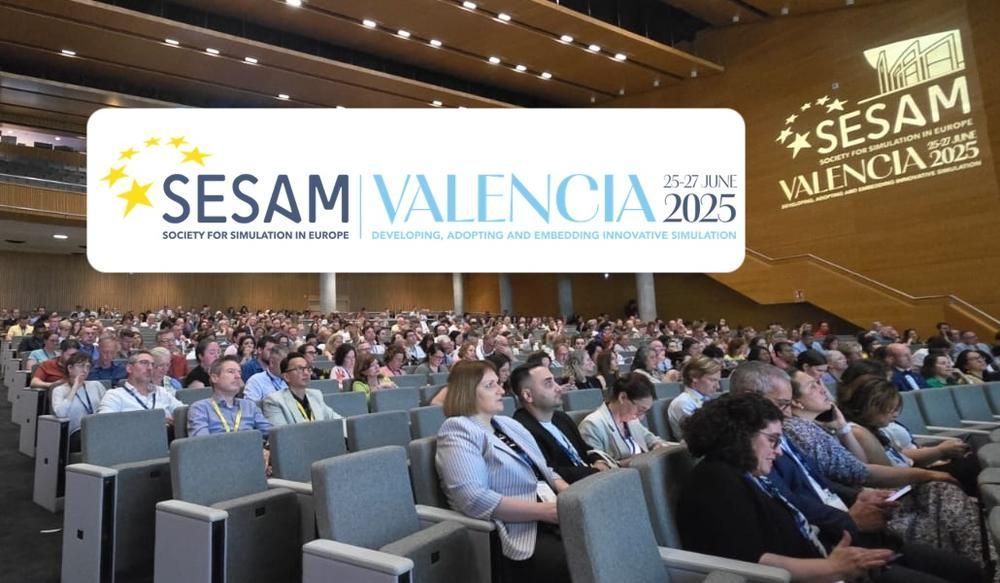
The 30th annual meeting of the Society for Simulation in Europe (SESAM) opened this morning in Valencia, Spain, drawing 1,377 attendees from 65 countries, including 568 first-time participants and 69 Ukrainian colleagues, united by one mission: advancing healthcare simulation across systems, disciplines, and borders. This year’s theme, “Developing, Adopting and Embedding Innovative Simulation”,echoed throughout the morning keynote and opening remarks, emphasizing that simulation is not just a tool, but a foundational element for building safer healthcare systems. Ferooz Sekandarpoor covered the event on behalf of SESAM Media Partner HealthySimulation.com.
SESAM President Pier Luigi Ingrassia Opens With a Call to Action
Newly appointed SESAM President Prof. Pier Luigi Ingrassia welcomed attendees with enthusiasm, reminding the audience that while the society celebrated 30 years of existence last year, this week marks the 30th official annual meeting of SESAM.
Ingrassia emphasized simulation’s evolving role in workforce development, patient safety, and health system transformation, highlighting international collaborations, including with the World Health Organization’s Quality of Care and Patient Safety Office and the European Patient Safety Foundation.
“These partnerships affirm that simulation belongs at the center of healthcare’s future—not on the fringes,” he stated.
Opening Keynote: Professor Carmen Gomar Sancho on the Spanish Simulation Journey
The opening keynote speaker for Day 1 was Professor Carmen Gomar Sancho, Director of Simulation and Patient Safety at the University of Vic – UCC (Campus UManresa) and University of Barcelona. Her session, titled “Development and Evolution of Simulation in Spain,” took attendees on a personal and institutional journey spanning nearly three decades of growth in the Spanish simulation ecosystem. She is the Chair of Clinical Simulation and Patient Safety at the University of ViC- Universitat Central de Catalunya, culminating a simulation career which commenced in 1997. She has previously held the Chair of Anaesthesiology at the University of Barcelona. Among other achievements, she has been an editor of 15 books, authored 216 book chapters and 246 publications in scientific journals. In her keynote, she will take us on a journey exploring the adoption of healthcare simulation in Spain, highlighting how key organisations and societies have contributed to shaping the current landscape of Spanish simulation-based practice.
Dr. Gomar outlined a timeline of progress, starting with the introduction of simulation into undergraduate curricula in 1997, while candidly addressing nine critical areas where clinical simulation still faces challenges in Spain today:
- Training and professionalization of teaching staff
- Integration into the healthcare system
- Standardized assessment and validation
- Equity of access
- Economic sustainability
- Interprofessional training
- Responsible technological innovation
- Specialized technical staff shortage
- Limited research infrastructure
Her message was clear: simulation must evolve from an academic enhancement into a systemic strategy supported by national policy, economic investment, and educational reform.
Other Day 1 Takeaways So Far
- Simulation is infrastructure, not accessory: Speakers emphasized simulation as central to health system performance, not just educational enhancement.
- Localization matters: Carmen Gomar’s session demonstrated how national ecosystems develop unevenly, requiring tailored strategies and intersectoral collaboration.
- Global impact grows: With new partnerships, translation of the Global Consensus Statement, and international guests, SESAM’s influence continues to expand.
Additional Plenary Sessions are planned this week from Mirka Cikkelova, General Secretary of the European Patient Safety Foundation (EUPSF), an independent foundation based in Brussels, Belgium, COL Dr. Fazekas, Director of the NATO Centre of Excellence for Military Medicine with Dr. Sonesson from King’s College London, and Dr. Laura Rock.
By the Numbers: A Record-Setting Year
One of the oldest healthcare simulation societies, SESAM 2025 marks the 30th anniversary of SESAM and the 31st year of the Society. The theme “Developing, Adopting, and Embedding Innovative Simulation.” A record-breaking number of abstracts (450+) were submitted this year, which led to a rich, varied scientific programme and the chance to bring the clinical simulation community together. Attendance at SESAM 2024 reached 1,300, with 60 countries represented and 561 first-time attendees. Approximately 50 vendors were present in a busy, interactive exhibit hall. There were 385+ presentations with 81 workshops.
View the HealthySimulation.com Webinar EU Simulation Resources From the SESAM Organization to learn more!
To summarize, SESAM 2025 launched with impressive statistics:
- 487 presentations
- 83 workshops
- 275 hours of educational content
- A 26% increase in abstract submissions over previous years
The exhibit hall buzzed with activity as over 50 vendors showcased the latest in manikins, software, VR/AR platforms, and system integration tools. HealthySimulation.com also participated, showcasing the new comprehensive global healthcare simulation vendor directory.
SESAM Day 2 Recaps
SESAM 2025 continued to build momentum on its second day with a lineup that centered on academic identity, inclusive scholarship, and a collective vision for the future of healthcare simulation. Simulationists enjoyed rich opportunities for networking, engaging with vendors, attending workshops, browsing ePosters, and exchanging insights that will shape their local and global practice.
Morning Keynote – Fostering a Scholarly Identity Through Simulation Leadership (Dr. Vicky Tallentire, Medical Education Directorate, NHS Lothian, Scotland): In a deeply inspiring and introspective keynote, Dr. Vicky Tallentire shared her journey of building a simulation-based research team within NHS Lothian’s Medical Education Directorate—responsible for training more than 1,000 doctors and hosting over 1,000 medical students across Edinburgh. Dr. Tallentire challenged three widely held assumptions in academic simulation leadership:
- That skills define scholarship: Through a powerful story of a simulation fellow who initially rejected the idea of being a “scholar,” Dr. Tallentire reframed scholarship not as a skill set, but as an identity. Her strategy? Create early, achievable wins—such as publishing academic letters—to ignite belief in one’s capacity to contribute meaningfully to the field.
- That research must be large-scale: She illustrated how even small, focused projects—when driven by passion and curiosity—can build confidence and credibility. From board games teaching growth mindset to peer-reviewed articles on equity and sustainability, her team’s grassroots ideas have matured into award-winning scholarship.
- That success is about picking the best people: Instead, Dr. Tallentire emphasized creating the right conditions for others to thrive. Drawing on metaphors of raising a puppy and hosting a party, she encouraged leaders to foster connection, psychological safety, and personal growth. “My job is not to choose the superheroes—it’s to host the party they want to come to,” she said.
She concluded by asking simulation educators to reflect on their own roles: Are you a brick—building foundations? A binder—connecting the pieces? Or an architect—shaping the vision? The message was clear: when we nurture belief, honor identity, and create space for others to grow, the next generation of simulation academics will emerge ready to transform the field.
Afternoon Panel – From Club to Community: Celebrating 30 Years of SESAM: This milestone panel highlighted SESAM’s evolution from a modest group of 25 anesthesiologists to a global network of over 1,000 simulation professionals. With a diverse panel of thought leaders across healthcare, engineering, and psychology, the session honored SESAM’s history while exploring the challenges and opportunities ahead.
- Barbara Esbjørn spoke about simulation’s growing role in mental health and wellness.
- Dr. Stella Major shared powerful reflections on how standardized patients shaped her empathy-based practice.
- Kirsimarja Metsävainio emphasized lifelong learning and peer mentorship in simulation networks.
- Alan Platt spotlighted the unique contributions of nursing to simulation pedagogy and global practice.
- Dr. Serena Ricci detailed how immersive technologies and biometric data are expanding the frontiers of training.
- Dr. Vitor Almeida brought the prehospital care perspective, reminding us of simulation’s critical role beyond hospital walls.
More About SESAM
The Society for Simulation in Europe (SESAM) is a healthcare simulation organization designed to encourage and support the use of simulation in healthcare for the purpose of training and research. Not affiliated with any medical or other specialties, the organization includes members with wide and varied backgrounds from within healthcare and medical education. All members have an interest and passion in medical simulation, and together they form a dynamic clinical simulation community filled with international protagonists of medical simulation across all of Europe.
Day 3 will continue the energy with a deep dive into simulation policy, equity, and the landmark Global Consensus Statement on Simulation-Based Practice. As simulation continues to evolve into a recognized discipline in its own right, SESAM is positioning itself as both a convener and catalyst for the field’s next chapter. Stay tuned to HealthySimulation.com’s social media accounts on LinkedIn and X (Twitter) for more exclusive highlights and practical takeaways from #SESAM2025, including sessions on artificial intelligence, immersive technology, debriefing innovations, and more.