
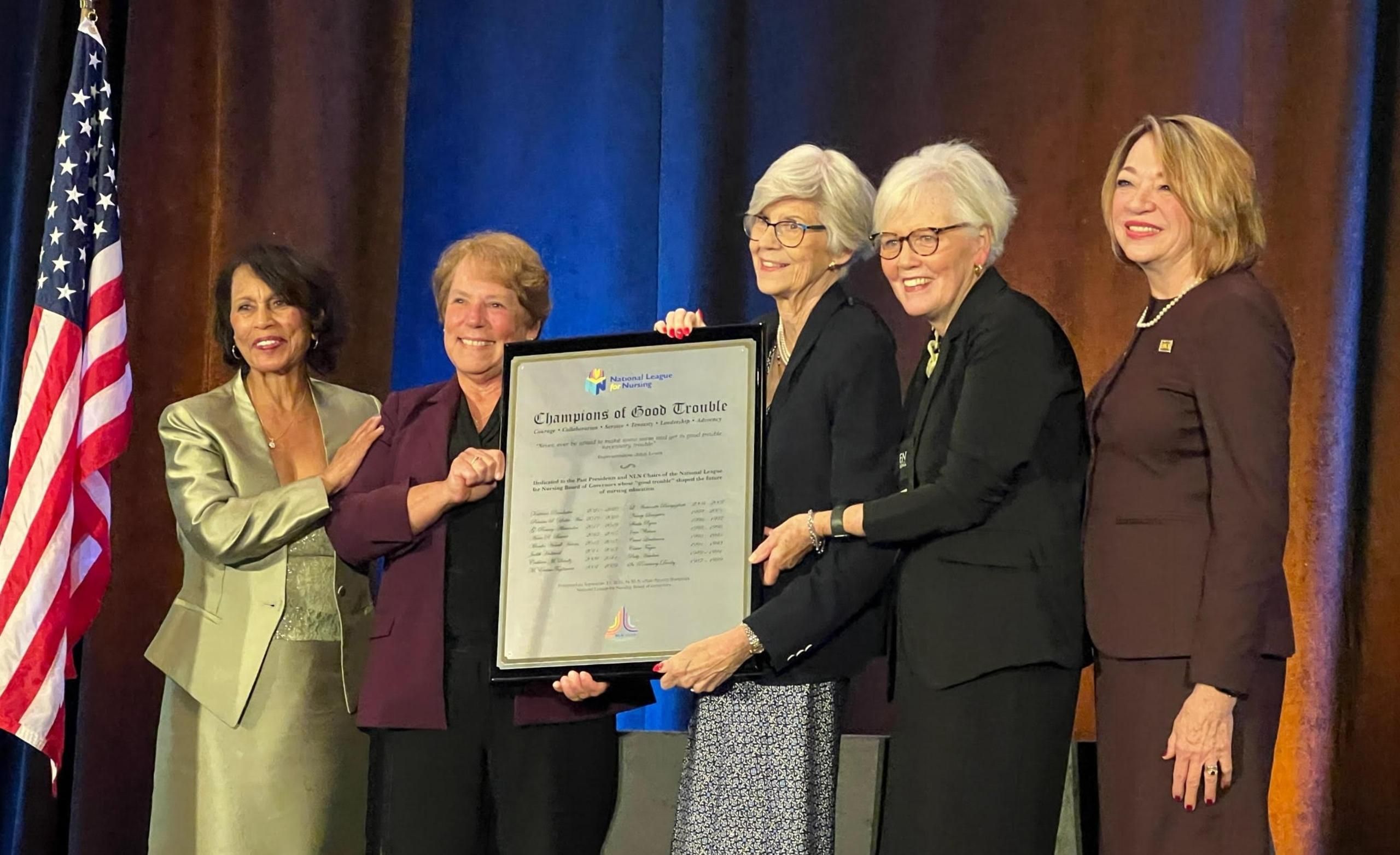
The NLN Education Summit 2025 was held this week in Orlando, Florida to bring nurse educators, academic leaders, researchers, and industry vendors together for three days to focus on emergent issues that shape nursing education. The central theme this year is artificial intelligence (AI) and how AI is transforming nursing education through teaching, learning, and curricula design. There were over 1000 attendees and 80 concurrent sessions. This HealthySimulation.com article by Content Manager Dr. Teresa Gore will highlight the key takeaways from the Summit as applied to healthcare and nursing simulation.
Keynote Speakers Explore Role of AI in Nursing Education
Three keynote speakers are featured with various perspectives on AI in nursing education.
Dr. Maxim (Max) Topaz was the opening keynote speaker and talked on Integrating AI into Nursing Education: Innovations, Challenges, and Practical Applications. He examined how AI technologies, especially in simulation‐based learning and data literacy, can and should be embedded in nursing education, as well as ethical issues like algorithmic bias, inaccuracies, and how curricula might evolve.
Dr. Cynthia Bradley was selected for the Debra L. Spunt Lecture and presented on From Headsets to Datasets: Empowering Nurse Educators to Use AI in Immersive Simulation & Beyond. In Dr. Bradley’s energizing and informative presentation, she stressed the importance of immersive VR experiences have the immersion power for nursing students to learn to think, behave, and act as professional nurses. The goal of nursing education has never changed: to develop nursing students to transition into practice as professional nurses who think critically to improve patient outcomes. She emphasized that AI is not to replace nurse educators, but to enhance their work. She introduced AI + NI = improved outcomes. NI is nursing intelligence.
VR measures provide the outputs on learner performance for nurse educators to measure and transform care. One must measure to improve and transform learning and patient care. She quoted Dr. Sue Forneris, “Teach with the end in mind.” Dr. Bradley informed the audience about the steps used to dissect cognitive functions, explaining how learners think and act.
- Datasets to measure what we can improve to transform outcomes Comment end
- Understand the frameworks first to apply in the appropriate context
- Prompt with purpose: prompt engineering to inform purpose
Matthew Byrne spoke at the National Faculty Meeting on The AI Revolution in Nursing Education. His presentation will likely tackle the balance between innovation and risk: what aspects of traditional pedagogy and clinical education should shift, what stay the same, and how faculty can navigate AI’s disruptive potential.
Together, these speakers establish a framework to explore AI as an opportunity that must be implemented thoughtfully, with awareness of its ethical, pedagogical, and systemic challenges.
Significance and Themes Across the Community
The NLN Education Summit 2025 is a landmark collaboration for nursing education with focused attention to AI, not just as speculation, but in terms of concrete applications, pedagogical innovations, and ethical implications. The blend of keynote speeches, and full exhibitor participation indicates both that the nursing education field regards AI as urgent and that purposeful integration will require collaboration across educators, technologists, accreditors, and institutions. The 2025 NLN Education Summit emerges at a pivotal time, with several intersecting trends:
- AI rapidly entered education and healthcare, and nurse educators must wrestle with how to integrate AI without compromising safety, equity, or pedagogy. The speakers at the summit addressed innovation implementation, but were mindful of bias, ethics, and rigorous evidence.
- Simulation and immersive technologies are not merely add‐ons, but are positioned as central modalities for preparing practice‐ready nurses. Data derived from simulations and virtual reality are acceptable educational evidence for competency assessment.
- The recognition of both veteran leaders (through NLN Awards) and emerging scholars (through research grants, the new Distinguished Emerging Nursing Scholar Award) illustrates the NLN’s dual commitment: to honor past contributions and to nurture future scholarship.
View the HealthySimulation.com Webinar Using Generative AI to Help Design Healthcare Simulation Scenarios to learn more!
Key Takeaways from NLN’s Nursing Education Summit
Key takeaways from NLN Summit 2025 delivered through keynotes, sessions, vendor showcases, and participant feedback revealed several themes:
Integration of AI with Pedagogy, Not Replacement: The consensus: AI tools (e.g., machine learning, generative models, data analytics) are best used to augment the educator’s role—improving feedback loops, simulation, student assessment—rather than replacing human judgment, especially in ethics, empathy, and clinical decision‐making.
Simulation & Immersive Learning as Central Platforms: Sessions highlighted how virtual reality, augmented reality, immersive simulation settings, and high-fidelity simulation are becoming more central in preparing nursing students. Also, that faculty training in using these tools (both technology and debriefing practice) is key.
Data & Assessment Innovations: The use of large data sets, learning analytics, adaptive assessment methods, and competence frameworks was discussed extensively. Several sessions presented research on how to enhance clinical judgment through structured reflection, repeated practice, and simulation performance metrics.
Ethics, Bias, Equity & Access: Many sessions addressed algorithmic bias in AI tools, equitable access to advanced technology for underserved programs and students, to ensure AI’s outputs are transparent, and that decisions driven by algorithms are interpretable. Concerns were raised about cost, digital infrastructure, and faculty support.
Faculty Development & Infrastructure: AI implementation, simulation, or immersive learning demands investment, not only in hardware, software, and new tools, but also in training, faculty workload, faculty mindset, and institutional support. Sustainable models for both financial and organizational were discussed.
Collaboration Across Stakeholders: Educators, vendors, technologists, healthcare institutions, accrediting bodies, and students need to work together. Vendor exhibits reinforced this: partnership models on how simulation providers collaborate with universities and publishers with AI features added were showcased.
Clinical Education Innovation: “Practice‐readiness” received renewed focus: what is expected of new graduates, how simulation and AI can help bridge gaps in clinical hours, how to manage preceptorships and placements to include remote and virtual experiences, and creative approaches to student placements.
View the new HealthySimulation.com Community AI in Healthcare Simulation Group to discuss this topic with your Global Healthcare Simulation peers!
Outcomes & Areas for Further Work
Here are what appear to be early outcomes, and what participants and NLN might continue to follow up on:
- NLN Vision Statement on AI in Nursing Education: The NLN has published a new Vision Statement on AI in Nursing Education, suggesting a commitment to guiding principles, ethics, adoption pathways, and perhaps policy recommendations.
- Scholarly Stimulus: The Summit seems to have stimulated research: calls for new studies about AI’s impacts, equity, cost/benefit, effect on faculty, and students’ outcomes. The “Best of NEP” and other grant award announcements likely energize academic programs.
- Faculty Capacity Building: Many attendees reported new ideas about how to build faculty capacity, both skill and confidence, with AI tools, simulation, debriefing, etc.
The 2025 NLN Education Summit represented a turning point in nursing education: AI is no longer a distant or theoretical concern, but a practical, rapidly advancing force reshaping simulation, assessment, curriculum, and clinical education. While many challenges remain, which include ethical, infrastructural, equity, and cost issues, the NLN Summit 2025 highlighted both the readiness and urgency among nurse educators to engage. NLN Summit 2025 was a success with the help of sponsors and vendors. Here is a list of some key sponsors and vendor participation:
- Laerdal
- Elsevier
- Nurse Hub
- HealthySimulation.com
- TruMerit
- Wolters Kluwer Health
- Columbia Southern University
- Duquesne University School of Nursing
- FSU
- Galen College of Nursing
- Nightingale College
- University of Central Florida College of Nursing
- University of South Florida College of Nursing
- Vanderbilt School of Nursing