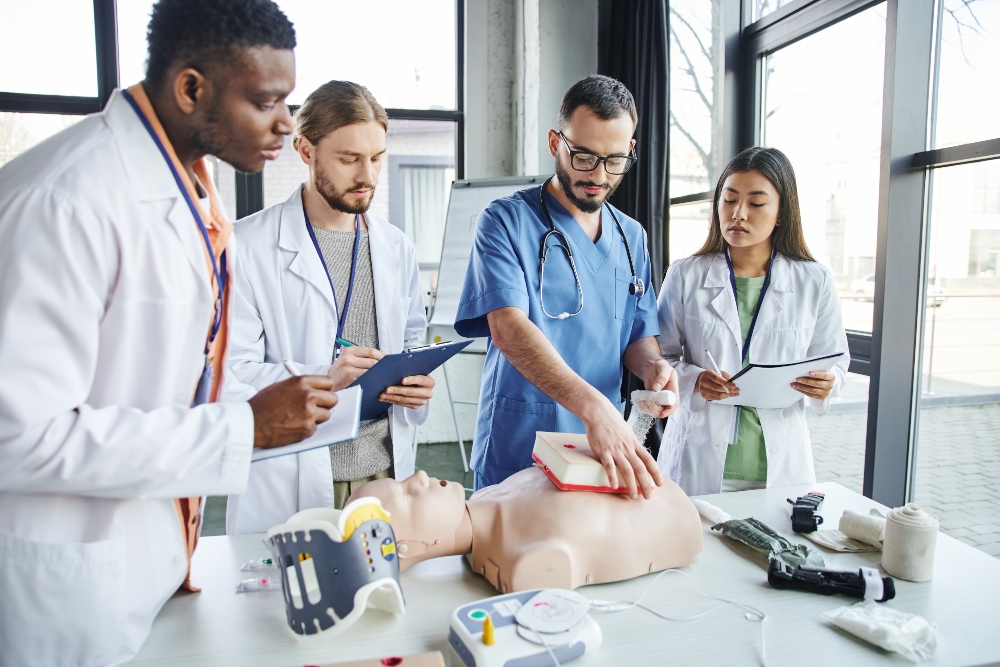


Healthcare simulation operations specialists face a unique professional challenge that extends beyond technical competence or operational excellence. Despite expertise in simulation technology, scenario design, and educational best practices, these professionals often struggle to have faculty members, particularly physicians and other advanced-degree clinicians, value their contributions or accept their feedback. To perceive a person as “just a sim tech” can undermine years of specialized knowledge and create barriers to effective collaboration. This article, by Rémy Roe, PhD, CHSE, CHSOS, explores evidence-based strategies for simulation operations specialists to establish credibility and build productive relationships with faculty despite credential gaps that create complex interpersonal dynamics.
The Authority Challenge in Healthcare Simulation
The credential gap between healthcare simulation operations specialists and faculty affects program quality and learner outcomes. While physicians and nurse practitioners bring clinical expertise and advanced degrees, simulation operations specialists possess specialized knowledge about educational technology, scenario fidelity, debrief techniques, and simulation best practices that faculty often lack. Recognition that these represent complementary rather than competitive skill sets forms the foundation for productive collaboration. Success requires healthcare simulation operations specialists to demonstrate value through actions and results, not just credentials.
Healthcare maintains deeply rooted hierarchies based on educational attainment and clinical credentials. Physicians often receive extensive socialization into hierarchical structures where authority correlates with degree level and clinical experience. Healthcare simulation operations specialists who often lack graduate degrees or clinical backgrounds may find that faculty dismiss their suggestions or question their expertise, regardless of their actual knowledge base or professional certification.
This authority gap manifests in multiple ways throughout simulation programs. Faculty may override technical recommendations without consultation, dismiss feedback about scenario design flaws, or fail to implement debriefing best practices despite operations specialist guidance. Some faculty view simulation technology as equipment to operate rather than recognize the pedagogical expertise required for effective implementation. Others may not realize that simulation facilitation requires specialized skills, particularly in debriefing and scenario design, that complement rather than replace clinical expertise
The challenge intensifies when operations specialists attempt to provide feedback about faculty performance throughout simulation sessions. Suggestions about facilitation techniques, debriefing approaches, or scenario management may provoke defensive reactions from faculty who interpret such feedback as criticism from someone they perceive as less qualified. This dynamic creates environments where operations specialists hesitate to share valuable insights, which ultimately compromises program quality and learner experiences.
View the HealthySimulation.com Webinar How Sim Techs Can Become Successful Team Members to learn more!
Build Credibility Through Demonstrated Competence
Healthcare simulation operations specialists must establish authority through consistent demonstration of expertise rather than reliance on credentials or titles. This approach requires strategic focus on visible contributions that faculty recognize as valuable and technically sophisticated. Technical excellence in scenario execution provides the foundation for credibility. Operations specialists should ensure flawless technology performance, seamless scenario progression, and rapid problem resolution when issues arise. Faculty notice when simulations run smoothly and when technical problems receive quick, professional responses. This reliability creates trust that extends beyond purely technical domains into educational aspects of simulation.
Anticipation of faculty needs demonstrates expertise and builds collaborative relationships. Operations specialists who prepare equipment before requests arrive, identify potential problems before they occur, or suggest solutions to challenges faculty have not yet articulated, establish themselves as valuable partners rather than support staff. This proactive approach shifts perceptions from “technician who operates equipment” to “expert who enhances educational outcomes.”
When a faculty member arrives with a scenario that requires learners to manage a difficult airway, an effective operations specialist might say, “I noticed your scenario includes cricothyrotomy. Our manikin does not have that feature, but I prepared three alternatives: we could use a hybrid approach with our airway trainer, modify the scenario to focus on the decision-making process without the procedure, or arrange for our OR suite simulator, which has that capability. Which approach best serves your objectives?” This response demonstrates technical knowledge, educational awareness, and solution-focused partnership.
Professional certifications from the Society for Simulation in Healthcare (SSH), such as the Certified Healthcare Simulation Operations Specialist (CHSOS) credential, demonstrate commitment to the field and validate expertise through external standards. While certification alone may not change faculty attitudes, it provides objective evidence of knowledge that can support other efforts to build credibility.
View the new HealthySimulation.com Community Simulation Technology Specialists Group to discuss this topic with your Global Healthcare Simulation peers!
Strategic Communication Approaches
How healthcare simulation operations specialists communicate with faculty significantly influences whether their input receives serious consideration. Strategic communication approaches help bridge credential gaps and ensure valuable expertise reaches decision-makers effectively. Clinical language adoption helps operations specialists communicate in terms faculty understand and respect. Rather than discuss “scenario fidelity” in abstract terms, operations specialists might reference how specific technical choices affect learners’ ability to recognize clinical presentations they will encounter in practice.
For example, instead of “The fidelity is not high enough” try, “Without the cardiac monitor waveforms, learners will not be able to recognize the ventricular tachycardia pattern you want them to identify. Can we use our advanced manikin, or would you prefer to focus on the treatment algorithm once they receive the diagnosis?”
Moreover, evidence-based recommendations carry more weight than opinion-based suggestions. Operations specialists should reference research, cite best-practice guidelines from organizations like SSH and INACSL, or describe successful implementations at peer institutions. Statements like “Research published in Simulation in Healthcare demonstrated that immediate debriefing improved skill retention by 40%” prove more persuasive than “I think we should debrief right away.”
Question-based guidance allows faculty to reach independent conclusions and receive expert direction. Rather than state “this scenario won’t work with our current equipment,” operations specialists might ask, “Have you considered how learners will manage the airway without our advanced manikin features?” This approach preserves faculty autonomy and ensures technical realities inform scenario design. Collaborative problem solution positions healthcare simulation operations specialists as partners rather than subordinates. Phrases like “Let’s figure out how to achieve your objectives with our current capabilities” or “What if we modified the scenario this way to better match learner needs?” invite joint ownership of solutions.
Document and Share Expertise
Visible demonstrations of knowledge help establish healthcare simulation operations specialists as subject matter experts whose input merits serious consideration. Written resources that address common faculty questions or challenges position operations specialists as authoritative sources of information. Brief guides on scenario design principles, equipment capabilities, or debrief frameworks provide value and demonstrate depth of knowledge.
Educational presentations to faculty groups showcase expertise while they provide genuine value. Operations specialists might offer workshops about clinical simulation best practices, updates on new technologies, or reviews of relevant research. These presentations should focus on practical applications rather than theoretical concepts. Finally, scenario design consultation services formalize operations specialist contributions to educational plans. Through the offer of a structured review of draft scenarios with feedback about feasibility, fidelity, and learner appropriateness, operations specialists create regular touchpoints where faculty experience their expertise firsthand
More Than Just a Sim Tech: Part 2
Healthcare simulation operations specialists who face credential gaps with faculty must establish authority through strategic credibility development, effective communication, and visible demonstrations of knowledge. This article by Rémy Roe, PhD, CHSE, CHSOS, has outlined foundational strategies for operations specialists to build professional credibility despite educational background differences. Part 2 of More Than a Sim Tech will address navigation of faculty resistance, conflict resolution approaches, and long-term relationship development strategies that transform operations specialists from support staff into recognized experts.
Learn More About Sim Tech | Simulation Technician | Simulation Technology Specialist!