
Healthcare simulation educators are trained to prepare healthcare professionals for high-acuity, high-risk environments. But this summer, the UCSF Kanbar Simulation Center took a different approach. One that reimagined who our learners could be and when the learning journey should begin. The third cohort of four high school students from the San Francisco Unified School District (SFUSD) was welcomed into a six-week immersive internship focused entirely on simulation-based healthcare education. The goal was to provide access, inspire confidence, and foster early interest in healthcare careers through a structured, hands-on learning experience. This HealthySimulation.com article by Genevieve Charbonneau, MS, BA, EdD, will describe one university simulation program’s efforts to broaden their focus to high school students.
Recently featured on ABC7 News (ABC7, 2024), this program was part of a broader SFUSD citywide initiative that placed high school students in paid summer internships across UCSF’s campuses. The healthcare simulation center collaborated with UCSF’s Center for Science Education and Outreach to design a simulation-centered pathway that engaged learners from historically underrepresented communities. The introduction of foundational clinical skills, peer teaching opportunities, and interprofessional simulation scenarios, the healthcare simulation team created an environment where students not only observed healthcare but also practiced and applied the skills. “I never thought I’d be teaching CPR before I turned 18,” one student said, fresh from leading a hands-only CPR session for visiting middle and high schoolers at the UCSF Kanbar Simulation Center. That moment captured everything this internship aimed to achieve.
View the HealthySimulation.com Webinar Using Healthcare Simulation for High School Education to learn more!
Program Design and Objectives
The UCSF High School HealthcareSimulation Internship was designed with four central objectives:
- Provide hands-on, simulation-based exposure to healthcare
- Build early competence in core clinical and communication skills
- Support career exploration through mentorship and self-reflection
- Promote equity in health professions education by reducing access barriers
To meet these goals, the simulation team developed a structured curriculum that introduced interns to both technical and affective competencies. Over the course of six weeks, interns participated in simulation and skills training sessions that included:
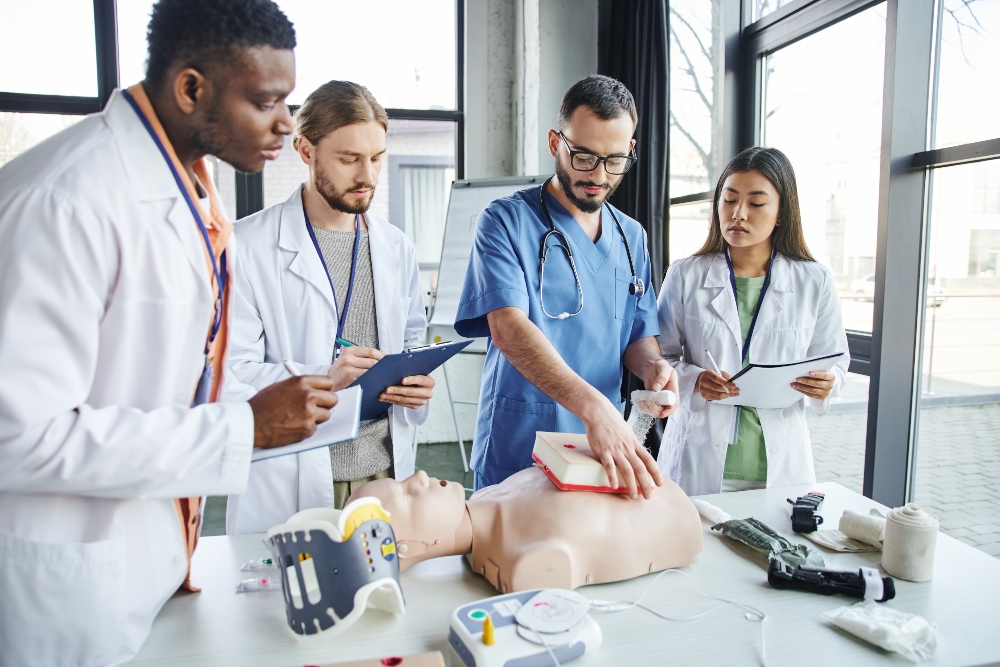
- Basic Life Support (BLS) and AED usage
- Airway management with bag-valve-mask ventilation
- Phlebotomy practice using task trainers
- Proper PPE donning and doffing
- Vital sign assessment, patient positioning, and maintaining sterility
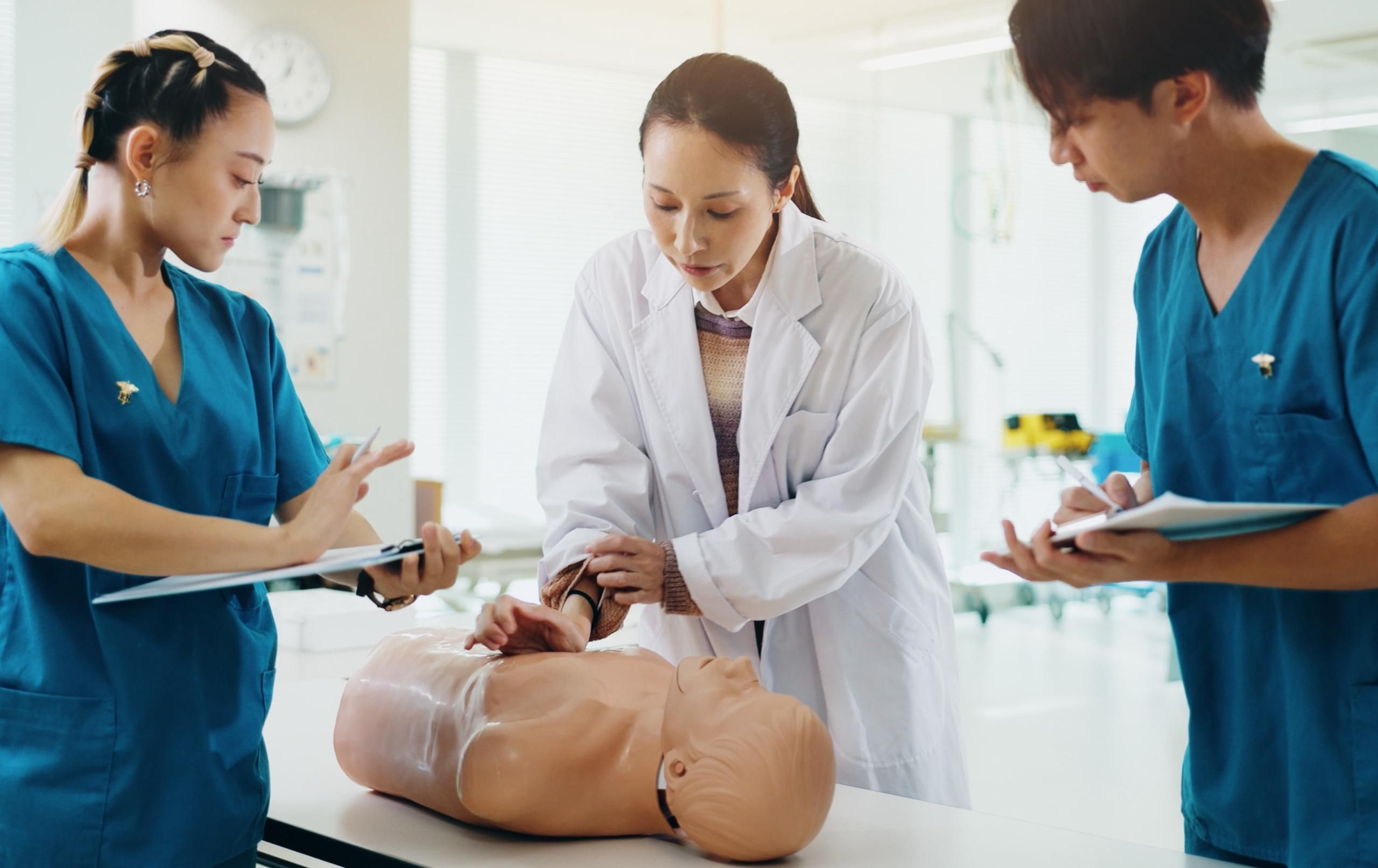
- Team-based clinical scenario simulations using the SimMan 3G high-fidelity manikin
- Facilitated debriefing following every hands-on experience
Additionally, the program introduced simulation best practices such as prebriefing, in-scenario role-playing, and interprofessional collaboration. Interns also built a final deliverable: a student-led CPR workshop for middle and high school students visiting UCSF for career exposure.
HealthcareSimulation as a Tool for Equity and Early Exposure
Healthcare simulation-based education is often reserved for medical, nursing, or allied health learners well into their clinical training. But the team believes simulation is just as, if not, more transformative for early-stage learners. Many of the interns were first-generation, college-bound students. Several began the program unsure if healthcare was the right path. Yet within the first week, they applied clinical reasoning, practiced sterile techniques, and coached each other through mock patient assessments. By the final week, they were able to facilitate scenarios, communicate calmly under pressure, and conduct CPR sessions for their peers.
“Because they come here and experience healthcare simulation firsthand, they want to pursue careers in healthcare, which is incredible,” Genevieve shared during the ABC7 interview (ABC7, 2024). She witnessed students grow in both confidence and clarity, through visualization to see themselves in these roles. When young learners are welcomed into simulation spaces, especially ones they typically do not access until years later, Charbonneau says that they begin to visualize new futures. Healthcare simulation reshapes how high school students view their academic identity and career potential. In this way, healthcare simulation becomes more than just a training method. Healthcare simulation becomes a social equalizer and catalyst of inclusion.
This aligns with current literature, which highlights how early healthcare exposure, particularly in underrepresented communities, can have a measurable impact on students’ long-term interest and participation in the health professions (Woods-Giscombé et al., 2015; Odom et al., 2020).
View the new HealthySimulation.com Community Scenario Design Group to discuss this topic with your Global Healthcare Simulation peers!
Peer Teaching as Practice-Based Mastery
One of the most impactful components of the internship was peer teaching. After completion of their CPR and BLS training, interns prepared to teach hands-only CPR to middle and high school students who visited the simulation center. This flipped the learning environment and empowered the interns to become facilitators, not just learners.
The results were powerful. Interns modeled airway techniques, coached compressions, and explained emergency response steps with confidence and empathy. For many, this was their first time as a leader in an educational experience. For the UCSF Kanbar healthcare simulation team as educators, healthcare simulation was a masterclass in applied learning.
“I felt like I was doing something important,” one intern reflected. “Teaching CPR makes me feel like I can help save lives, even if I’m not a doctor yet.”
This aspect of the program brought several benefits:
- Deeper retention of content through the act of teaching
- Enhanced communication and leadership skills
- Boosted self-efficacy and sense of competence
- Validation as future contributors to healthcare
The structure mimicked healthcare simulation-based team training for licensed professionals but was developmentally tailored to high schoolers. Their ability to teach others reflected a strong grasp of the material, and more importantly, their readiness to lead.
Building Belonging Through Safe Learning Environments
At the Kanbar Simulation Center, the healthcare simulation team prioritizes psychological safety, inclusion, and identity-affirming practices. These same principles were applied to the design of our internship. Interns were encouraged to ask questions, make mistakes, and practice self-assessment in a nonjudgmental environment.
The healthcare simulation team utilized structured prebriefing sessions to establish expectations, introduce clinical roles, and confirm that interns were full participants. Debriefing followed every simulation, emphasized reflection, connection, and emotional intelligence alongside clinical content.
Several interns remarked that the experience helped them “feel like they belong” in healthcare, even if they hadn’t previously envisioned themselves in a medical white coat. That sense of belonging is a critical ingredient to diversify the pipeline and retain students through the rigorous paths ahead.
Lessons Learned and What Comes Next
This internship was an investment in time, staffing, and curriculum development, but the return was undeniable. Students left more prepared, more informed, and more inspired. The healthcare simulation staff sharpened their teaching and coaching skills for a new learner population. And UCSF strengthened their outreach mission in alignment with its DEI goals.
Moving forward, the UCSF Kanbar Simulation Center aims to:
- Expand internship slots to include more SFUSD students annually
- Strengthen the mentorship component by pairing interns with UCSF learners of similar backgrounds
- Develop evaluation metrics to assess long-term impacts on student confidence, career interest, and college pathway selection
- Share this model with other healthcare simulation centers and academic institutions seeking to improve equity in their outreach
High school students are often underestimated in their ability to engage with complex healthcare content. This internship proved otherwise. Healthcare simulation can spark curiosity, instill confidence, and even unlock identity. When done with intention and inclusion, it becomes a powerful tool for equity. As one intern wrote in their final reflection: “This program made me feel like I mattered in a hospital. Like one day, I could actually be part of this world.” That’s the power of simulation, when we open the doors wide enough.
Learn More About Medical Training for High School Students!
References
- ABC7 News. (2024, July 1). SFUSD high school students get hands-on experience in UCSF internships. https://abc7news.com/post/sfusd-high-school-students-get-hands-experience-internships/15066270
- Odom, K. L., Roberts, L. M., Johnson, T. R. B., & Cooper, L. A. (2020). Exploring Obstacles to Diversity in the Physician Workforce: An Analysis of Survey Data. Academic Medicine, 95(2), 243–250. https://doi.org/10.1097/ACM.0000000000002950
- Woods-Giscombé, C., Rowe, M. A., Taylor, H., & Underwood, S. (2015). Increasing diversity in the nursing workforce: Programs, strategies, and lessons learned. Nursing Clinics, 50(2), 231–243. https://doi.org/10.1016/j.cnur.2015.02.006