

The coming years will be defined by the Smart use of AI in healthcare education. Simulation leaders across healthcare are navigating a perfect storm: rising learner demand, clinical staffing shortages, and flat or shrinking budgets. According to the World Health Organization, the global healthcare workforce shortage will reach 10 million by 2030. In the U.S., the AAMC predicts a shortage of up to 124,000 physicians by 2034. Nursing turnover continues to outpace onboarding in many systems. As these pressures mount, clinical simulation programs must rethink how to deliver scalable, high-quality clinical training without overextending educators or infrastructure. The answer is not doing more with less; instead, be smarter with what you already have. This is where AI comes in. This HealthySimulation.com article will highlight how Lumeto’s InvolveXR can address AI-enabled healthcare simulation challenges.
Lumeto’s InvolveXR: A Proven AI-Enabled Simulation Platform
Lumeto’s InvolveXR is the healthcare simulation platform built for today’s challenges. It leverages the power of artificial intelligence to save faculty time, enhance learner autonomy, and scale immersive and screen-based training. Whether onboarding nurses, scaling compliance training and interprofessional education, preparing international clinicians, or expanding OSCE-style practice, InvolveXR is designed to do the heavy lifting so educators can focus on what matters most, mentoring and clinical reasoning development.
Automate Reporting and Feedback with AI
InvolveXR automates performance tracking and reporting for every simulation session. Educators no longer need to manually score or document learner performance. The platform provides detailed post-session reports that break down learner actions, communication, and
Decision-making that frees up hours of faculty time and enables timely, personalized debriefs. This also enables self-directed learning experiences for learners from anywhere, anytime, which provides more practice and training time at no incremental cost. The best part is that all of the assessments are completely customizable to suit organization and program-specific training goals.
Webinar Invitation: See the Research in Action
Register and Attend the Upcoming CE Webinar: Comparing Standardized Patients vs AI-Enhanced Virtual Patients in Clinical Training June 3, 2025, at 12PM EDT/ 9AM PDT.
This CE webinar will be presented by an esteemed scholar in healthcare simulation, Dr. Nicole Harder, University of Manitoba. This CE webinar will showcase study results showcasing the comparison between SPs and AI-enhanced virtual patients for undergraduate nursing education. Discover how AI-powered Simulated Patients can supplement your SP program and expand communication training without expanding your budget. Dr. Harder will present results from her peer-reviewed study comparing AI-based and live SPs.
Supplement Standardized Patient Programs with AI-Enabled Simulated Patients
Live Standardized Patients (SPs) remain invaluable in simulation. But AI-enabled Simulated Patients in InvolveXR offer a powerful supplement, especially for programs that face budget or scheduling constraints. These virtual patients engage in natural, emotionally responsive conversation and adapt to learner input in real time. They are ideal for foundational communication training, repeated practice, and early-stage exposure. Live SPs can then be reserved for advanced or high-stakes assessments to maximize impact and minimize cost.
Dr. Nicole Harder’s peer-reviewed study at the University of Manitoba found that learners who engage with AI-enabled Simulated Patients demonstrated comparable outcomes to those working with live SPs, which makes this an evidence-based way to extend SP program reach.
New Screen-Based Simulation Mode: High-Fidelity Training, No Headset Required
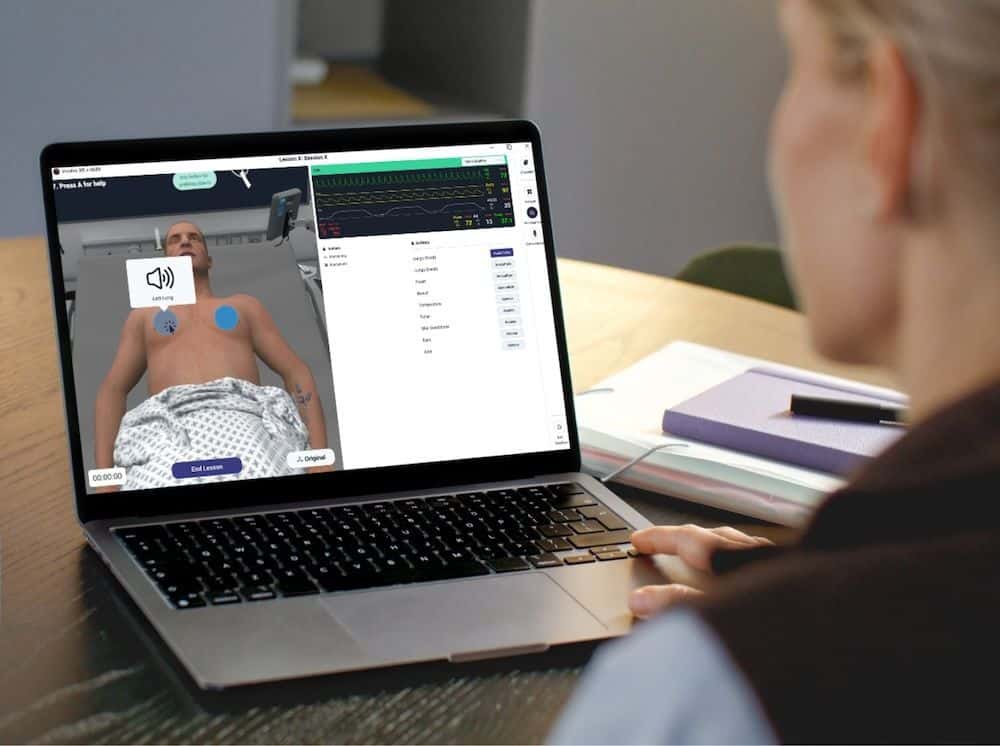
InvolveXR’s new screen-based mode brings the full power of AI-driven simulation to any laptop or desktop and requires no VR headset. This reduces infrastructure costs, expands learner access, and simplifies deployment. Screen-based simulation is perfect for hybrid programs, asynchronous learning, and institutions looking to pilot high-quality simulation without the upfront investment in hardware. With the same intelligent AI coaching and feedback, learners gain clinical confidence through repeatable, self-paced practice.
Real-World Use Cases: Save Time and Scale Access
Hospitals that use InvolveXR can accelerate nurse onboarding and offer core clinical and communication training modules that learners complete independently. AI-driven feedback and automated reports allow preceptors and educators to focus on critical clinical integration, not introductory repetition.
Expand Access to or Introduce Standardized Patient (SP) Training At Optimized Costs
AI-enabled Simulated Patients allow schools and hospitals to cost-effectively scale their SP training. Institutions can use InvolveXR to supplement their current SP programs to enable more learners to get more repetitions, even before their first live patient encounter. For institutions that find SP programs cost-prohibitive, InvolveXR’s AI-enabled Simulated Patients are a low-cost way to introduce such training.
“I have been struck by how working with AI patients on Lumeto’s InvolveXR platform evokes an emotional response that mirrors interactions with human patients. The joy of making a breakthrough in patient communication or the sadness felt during a patient’s distress highlights the system’s realism and immersiveness. This emotional engagement makes each simulation a powerful tool for honing empathetic and professional skills as a nurse.” stated Kimberly Workum RN, BScN, MEd, CHSE, CCNE, Director, Clinical Competence Assessment Centre and Digital Strategies, University of Manitoba
Prepare Internationally Educated Clinicians Faster
Bridging clinical and communication gaps for internationally educated healthcare professionals is complex. InvolveXR offers a consistent, repeatable, and high-fidelity training pathway that aligns with North American care standards, which helps clinicians become practice-ready more efficiently.
More OSCE-Style Training, Less Faculty Time
Institutions can run OSCE-style practice scenarios within InvolveXR, complete with AI-generated assessments and scenario branching. Learners practice repeatedly, and educators spend less time facilitating and scoring, while still tracking performance over time.
View the new HealthySimulation.com Community AI in Healthcare Simulation Group to discuss this topic with your Global Healthcare Simulation peers!
Scaling Compliance and Interprofessional Training
Compliance training often presents logistical challenges, from the coordination of space to the alignment of schedules across disciplines by faculty. InvolveXR solves this through self-paced, AI-guided simulations that replicate common compliance scenarios such as stroke recognition and escalation, delirium management, and infection prevention and control.
At Royal Victoria Regional Health Centre (RVH), InvolveXR has been used for Stroke Training among residents, nurses, and interprofessional teams. Now, their Stroke Team is looking to add this to their accreditation program for hospital-wide stroke training. Here’s an article illustrating RVH’s journey with InvolveXR. “When we first showed off the AI stroke case, it completely changed how we saw the potential of this platform. It wasn’t just new—it was better,” stated Mitch Greene, Manager, Medical Education, Simulation and Physician Assistant Program, Academic and Medical Affairs, RVH.
This model can be applied to any system-level compliance priority. Whether to meet the annual recertification requirements or address clinical risks, simulation-based compliance becomes more consistent, accessible, and efficient with InvolveXR. From the delivery of bad news to interprofessional tension navigation, communication training is essential across healthcare. InvolveXR’s AI-driven simulations provide scenario-based practice for a wide variety of communication competencies, tailored to each learner’s responses.
A Platform Built for the Simulation Community
InvolveXR was built for simulation professionals, not as an experiment, but as a practical, scalable solution to today’s challenges. Its AI capabilities are research-backed, educator-tested, and learner-approved. Whether your institution faces staffing shortages, simulation backlogs, or limited budget, InvolveXR helps you do more of what works, with less time and cost.
Scale Simulation Smarter, Not Harder
Simulation programs do not need to stretch themselves thinner. With Lumeto’s InvolveXR, educators gain an intelligent, scalable solution that delivers measurable time savings, training consistency, and clinical readiness. From AI-enabled Simulated Patients and other characters to auto-generated reporting to VR and screen-based access, InvolveXR is the most advanced simulation platform available and ready for integration into your program today.
More About Lumeto
Lumeto is a software development company that was founded in 2021 to enable the future of work through an advanced XR simulation, training, and skills assessment platform named InvolveXR. The platform enables institutions looking to deploy data-driven, enterprise-grade, immersive training and assessment across their workforce. Headquartered in Toronto, Ontario, the company operates across the healthcare and safety fields, with the goal to enhance learning outcomes tied to individual and team decision-making, problem-solving, de-escalation, and complex procedures.