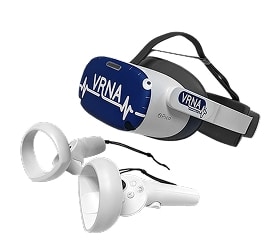
VRNA, developed by VRSim, is an innovative virtual reality (VR) training system that revolutionizes healthcare education by providing immersive, hands-on skills training for nursing assistants, patient care technicians, and emergency medical responders. Based in East Hartford, Connecticut, VRSim has been a pioneer in creating practical VR teaching tools since 2002. VRNA serves as a complementary tool to traditional lab instruction, offering a cost-effective and efficient method for students to practice and master essential patient care skills in a safe, controlled environment. By leveraging VR technology, VRNA enhances the learning experience, reduces instructor workload, and ensures students are well-prepared for real-world clinical scenarios.
Summary of Key Products/Services from VRSim
VRSim’s flagship product, VRNA, offers a comprehensive suite of training modules designed to meet the diverse needs of healthcare education programs. These modules are tailored to align with state and national certification requirements, ensuring that learners acquire the competencies necessary for their respective roles. The platform’s immersive simulations mimic on-the-job experiences, allowing students to develop confidence and proficiency in various patient care tasks. By providing instant feedback and detailed performance assessments, VRNA facilitates continuous improvement and skill mastery.
- Certified Nursing Assistant (CNA) Training Modules: Covering over 35 essential skills, including ambulation assistance, bed baths, catheter care, and vital sign measurement.
- Emergency Medical Services (EMS) Training Modules: Encompassing critical procedures such as CPR, airway management, bleeding control, and patient assessment.
- Performance Portal: A feature that tracks learner progress, provides real-time feedback, and allows instructors to monitor and assess student development effectively.
- Multilingual Support: Offers both written and spoken task instructions in English and Spanish, enhancing accessibility for a diverse student population.
- Portable VR Headset: An all-in-one device that facilitates easy setup and use in various training environments, from classrooms to remote learning settings.
More Detailed Product / Service Offerings
The Certified Nursing Assistant (CNA) Training Modules within VRNA provide learners with immersive scenarios that replicate real-life patient care situations. These modules cover a comprehensive range of skills, including ambulation assistance with devices like canes and walkers, bed baths, catheter care, and vital sign measurement. Each scenario guides students through step-by-step procedures, allowing them to practice and refine their techniques in a risk-free environment. The immediate feedback and scoring system enable learners to identify areas for improvement, fostering confidence and competence in their caregiving abilities.
The Emergency Medical Services (EMS) Training Modules are designed to prepare first responders for high-pressure medical situations. These modules include critical procedures such as CPR, airway management, bleeding control, and patient assessment. By simulating emergency scenarios, VRNA enables trainees to develop decision-making skills, procedural accuracy, and confidence. The realistic simulations ensure that learners are well-prepared to handle real-world emergencies effectively, ultimately improving patient outcomes.
The Performance Portal is an integral component of VRNA, offering educators a robust tool to monitor and assess student progress. This feature provides real-time feedback, detailed performance reports, and analytics that help instructors identify trends and address learning gaps. By facilitating data-driven instruction, the Performance Portal enhances the overall effectiveness of training programs and ensures that students meet competency standards.
Key Organizations / Institutions Clients
VRSim’s VRNA has been adopted by various educational institutions and training centers to enhance their healthcare programs. For instance, the Career Academy of Pella in Iowa integrated VRNA into their curriculum to provide students with practical experience in patient care. This implementation allowed learners to practice essential skills in a controlled environment, bridging the gap between theoretical knowledge and hands-on application. Additionally, organizations like the Delta Area Economic Opportunity Corporation (DAEOC) in Missouri have utilized VRNA to support workforce development initiatives, preparing individuals for careers in healthcare by offering immersive training experiences.
Key Partnerships/Acquisitions
VRSim has established strategic partnerships to expand the reach and impact of VRNA. Collaborations with distributors such as Tech-Labs and Amtek Company have facilitated the integration of VRNA into educational institutions and training centers across the United States. These partnerships have enabled VRSim to provide comprehensive support and resources to clients, ensuring the successful implementation of VRNA in diverse learning environments.
Who Should Consider Purchasing VRNA and Why
Educational institutions offering nursing assistant, patient care, and emergency medical responder programs should consider integrating VRNA into their curricula. The platform provides a cost-effective solution to traditional training methods, reducing the need for extensive physical resources and minimizing instructor workload. By offering immersive, hands-on practice opportunities, VRNA enhances student engagement and skill acquisition, leading to improved competency and job readiness. Healthcare organizations focused on workforce development can also benefit from VRNA by providing current employees with a tool to refresh and enhance their skills, ultimately improving patient care quality and safety.
Additional Benefits of VRNA
- Enhances accessibility to quality training through multilingual support and flexible deployment options.
- Provides immediate feedback and performance tracking through the Performance Portal, helping learners and instructors monitor progress effectively.
- Reduces training costs by minimizing the need for physical equipment and consumable resources.
- Supports remote and hybrid learning models, enabling students to practice essential skills outside the traditional classroom setting.
- Improves student confidence and readiness by simulating realistic healthcare scenarios in a controlled, risk-free environment.
Final Considerations of VRNA
VRNA represents a significant advancement in healthcare simulation, leveraging virtual reality technology to enhance the training of nursing assistants, patient care technicians, and emergency medical responders. By offering an immersive, interactive learning experience, VRNA equips students with the necessary skills to succeed in real-world clinical environments. The platform’s detailed performance tracking, multilingual support, and adaptability make it a valuable tool for healthcare educators and workforce development programs.
Disclosure: The information on this page may be inaccurate or out of date. Create a free account and click the ‘Contact Vendor’ button for direct communication with the company for the latest updates.
 1313 Disneyland Dr, Anaheim, California, 92802, United States