
In the transition from student to healthcare professional, the multi-patient scenario represents the ultimate assessment of a senior nursing student’s readiness. However, without a deliberate instructional framework, these complex simulations can lead to cognitive overload, where learning stops because the brain’s working memory is overwhelmed. The combination of Cognitive Load Theory (CLT) with the SimVS technological ecosystem allows educators to create a scaffolded environment that balances task complexity with realistic clinical data with direct alignment to the AACN Essentials for pre-licensure graduates. This HealthySimulation.com article by Content Manager Dr. Teresa Gore explores the application of cognitive load theory with SimVS monitors and multiple patient scenarios to scaffold experience into real life application. See all HealthySimulation.com content about SimVS in their vendor directory listing.
How to Manage the Mental Control Panel
Cognitive Load Theory posits that working memory is a “bottleneck” that can only process a few chunks of information at once. To optimize this, educators must manage three types of load:
- Intrinsic Load (The Task): The inherent complexity of managing multiple patients at varying levels of acuity.
- Extraneous Load (The Noise): Distractions or poor technology. SimVS reduces this by providing intuitive, tablet-based interfaces that mimic real-world medical devices and prevent students from struggling with the “how-to” of the technology itself.
- Germane Load (The Signal): The deep mental work of schema construction with technology to increase the student’s ability to seek out critical data, such as fingerstick blood sugar (FSBS) or vital signs.
Come Visit SimVS at IMSH Booth #1142 to
Learn More About the Multi-Patient Simulation Package!
SimVS as the Technological Backbone
The SimVS platform functions as a comprehensive ecosystem that provides the nervous system for the nursing simulation lab that offers realistic data points across four distinct patient acuities. Each patient in the nursing simulation scenarios has four levels: immediate need, urgent need, routine need, and low-priority need. These acuity levels allow nursing students to prioritize the patient’s care and delegate to appropriate personnel. Each patient has all four levels available to select for the nursing simulation. Here is an example of four patients for a multi-patient scenario:
- Patient 1 Level A – Immediate: Med-Surg diabetic patient who is unresponsive and snoring. This represents a life-threatening hypoglycemic crisis. The SimVS Hospital Series provides the main monitor with normal vitals, which forces the learner to use the SimVS Nucleus diagnostic interface to reveal a critical FSBS of 42 mg/dL. This addresses AACN Domain 2 (Person-Centered Care), which requires the integration of assessment skills with point-of-care testing.
- Patient 2 Level B – Urgent: A post-op knee replacement patient with 8/10 pain and oxygen saturation 89%. Learners must utilize the SimVS-IV Series to simulate the administration of PRN morphine while monitoring for respiratory depression on the SimVS Hospital monitor. This aligns with AACN Domain 5 (Quality and Safety) with an emphasis on early recognition of post-op complications.
- Patient 3 Level C – Routine: An asthma patient and high fall risk, uses the SimVS Nurse Call system to request help to the bathroom. This creates a competing priority that tests the nursing student’s ability to delegate to a Patient Care Tech (PCT) and integrate AACN Domain 6 (Interprofessional Partnerships).
- Patient 4 Level D – Low: Stable patient admitted with pneumonia on IV antibiotics and requires education on incentive spirometry (ICS) and pulmonary hygiene. This nursing simulation uses the SimVS Nurse Station, and the faculty can observe the learner’s ability to safely defer this lower-acuity task until more urgent needs are met or delegate to the PCT to have the patient perform ICS. This incorporates AACN Domain 9 (Professionalism) and leadership.
View the HealthySimulation.com Webinar How to Fill Simulation Center Technology Gaps with SimVS to learn more about SimVS!
The Scaffolding Multiple Patient Strategy: Sit, Stand, Walk, Run
Effective simulation design follows a “Sit, Stand, Walk, Run” scaffolding approach. For first-semester nursing students to learn the role of nursing, SimVS allows faculty to design an experience with a stable medical-surgical patient and to simulate what to expect in the inpatient healthcare setting.
For the medical-surgical course, SimVS allows nursing students to provide care for one patient at the start of the semester to gain confidence for application of knowledge in a safe environment. Later in the semester, the nursing students can provide care for two medical-surgical patients. The SimVS multi-patient system allows faculty to select from a pre-set multi-patient scenario or combine any of the four patients at a faculty-selected acuity level (A-D) based on the curriculum needs and the disease diagnoses taught that semester.
For senior learners, the multi-patient scenario can be a three- to four-patient nursing simulation. This nursing scenario can be used as a preset scenario, or faculty can select one based on the acuity level to meet students’ and curriculum needs. This nursing simulation provides the student with clinical experience in which they can function as a graduate nurse and prioritize care for a group of patients. This nursing scenario has the role of a charge nurse and PCT to help with delegation, a skill that is in high demand but has little opportunity to practice in the clinical setting. Faculty use the SimVS Control App to manage all four patient stations from a single tablet and to trigger physiologic responses in real-time. By grounding high-fidelity technology in the science of how we learn, educators ensure that students do not just survive the nursing simulation but also develop the durable schemas required for professional practice.
SimVS Provides Medical Device Training At Scale
SimVS has emerged as a trailblazer in developing affordable simulated medical device technology. With a groundbreaking line of virtual patient monitors, assessment devices, IV Pumps, defibrillators, and more, SimVS has revolutionized how medical professionals and clinical students train and practice skills. Today, SimVS is one of the world’s most successful providers of simulated medical device monitors, boasting thousands of unit installations on devices across the globe.
SimVS offers a wireless, tablet-based virtual patient monitoring and simulation ecosystem designed to deliver high-fidelity clinical education with maximum flexibility, realism, and cost efficiency. The platform supports multi-modal simulation, making SimVS suitable for skills labs, in-situ simulation, hybrid learning environments, and large-scale academic programs. SimVS products provide a flexible, scalable, and learner-centered simulation solution that aligns with modern healthcare education needs that support realism, critical thinking, structured debriefing, and cost-conscious program development across nursing, EMS, and interprofessional training environments.
SimVS products are economical and provide the technology to support scenario-based error injections into the simulation to promote critical thinking, on-the-fly or pre-programmed scenarios that can be modified on-the-fly, integrated media delivery with X-Rays, 12-Lead ECGs, labs, and VS to improve the realism, and time-stamped actions that are automatically recorded for objective debriefing.
View the new HealthySimulation.com Community Nursing Simulation Group to discuss this topic with your Global Healthcare Simulation peers!
SimVS Products for Multi-Patient Simulations
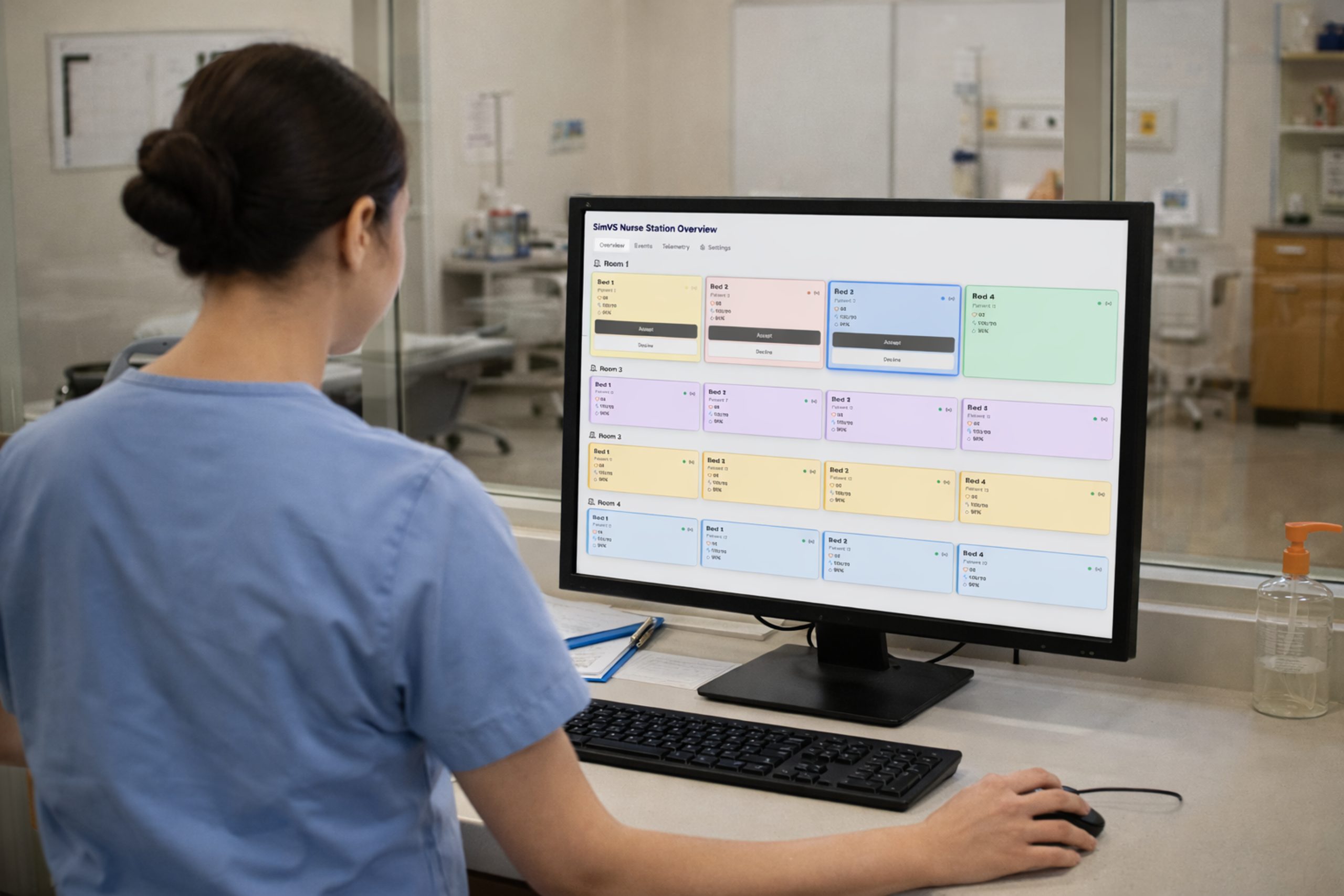
SimVS Nurse Station is the central hub for multi-patient simulation, providing real-time visibility and control across the entire unit. Faculty or teaching assistants playing the role of charge nurse receive a live overview of all active beds, call bell activity, Code Blue events, and vital signs. Seamlessly integrating with SimVS’s 20+ different monitor types, the Nurse Station brings realistic unit management training to life, teaching clinical prioritization and team coordination in multi-patient care environments.
SimVS Hospital is a clinical education solution that incorporates patient monitor, defibrillator, ventilator, and fetal monitor interfaces to create highly realistic bedside scenarios. This versatile platform integrates with standardized patients, manikins, or full-body simulators, supporting the development of critical thinking skills and pattern recognition.
SimVS Nurse Call is a wireless two-way communication system designed to mimic real hospital nurse call functionality. Students can request assistance, initiate Code Blue events, and communicate with instructors—all feeding directly into the Nurse Station for realistic alarm management and prioritization training.
SimVS Nucleus integrates four clinical areas into a single bedside system: Physiological Monitoring, Bedside Assessment, Two-Way Communication, and Medication Delivery. The Nucleus puts learners in the dynamic reality of patient care at an affordable price.
SimVS-IV is the first IV infusion pump simulator, featuring six interfaces, including a PCA pump. Students build skills in interpreting orders, managing infusions, administering bolus doses, and responding to alarms—perfect for both self-guided and instructor-led practice.